



In the wake of continued public backlash toward the actions of U.S. Customs and Border Protection (CBP), the U.S. Border Patrol (USBP), and Immigration and Customs Enforcement (ICE) after the apparent execution of U.S. citizen Alex Pretti in Minneapolis, the Trump administration appears to be backing down on continued deportation operations in Minnesota. Opponents of the administration’s broader immigration agenda now feel the wind at their backs, with many embracing radical measures such as abolishing ICE. Unfortunately, Democrats’ justifiable ire about these abuses toward immigrants and U.S. citizens has only further delayed the party’s necessary reckoning on the many immigration traps that twice handed Trump the presidency.
Although a plurality of Americans (46 percent) currently supports abolishing ICE, voters continue to believe that Republicans will do a better job than Democrats on both immigration and border security, by five and fifteen points, respectively. Outside of ICE, little to no effort has been made by elected officials to communicate exactly what—if any—of Trump’s immigration policies would be preserved or reformed by a future Democratic administration. The net result is many voters rightly fear that the next Democratic president will enable another free-for-all at the border.
Democrats appear poised to ride a wave of anti-incumbent backlash against Trump and the GOP in November and possibly in 2028. If, however, they are serious about winning and ultimately retaining working-class support, they should look beyond any individual election and enact a durable, pro-worker immigration agenda—one likely to irritate much of the party’s college-educated base. The groundwork for such a platform lies in making clear to voters that Democrats will champion humane but overwhelming enforcement against both illegal immigrants and the firms that exploit them. They should also embrace asylum reform and a points system modeled on neighboring Canada. Finally, Democrats should promote regional development in concert with pro-worker leaders abroad.
E-Verify, Amnesty, and First Principles on Immigration
The progressive worldview on immigration can functionally be described as a secular religion: Immigration is in all places and at all times a net good—except, of course, in cases where it undercuts college-educated professionals that just so happen to vote Democratic. In reality, whether it’s South Asians on H1B visas or illegal immigrants from Central America, the effect on native workers is the same. If you have a group of workers lacking basic rights that are also willing to work harder and for less pay than peers, the inevitable result is resentment from native labor.
Progressives contend hypocritically that non-college workers suffer no detriment from illegal immigration on account of the undocumented laboring in “jobs Americans won’t do.” They likewise cite neoliberal economics they would otherwise condemn, arguing that any immigration—legal or otherwise—is a net benefit to GDP. In reality, U.S. citizens work alongside illegal immigrants in countless fields, from agriculture to services to construction. The fact that the native workforce within these industries has declined in recent decades speaks to the devastating impact of neoliberal policies like mass illegal immigration on their respective wages. Employers benefit from both illegal labor and additional consumers, leading to higher GDP growth. But, like free trade, this doesn’t mean that the benefits of illegal immigration are spread equally, including abroad.
In 1990, the share of illegal farm workers in the U.S. was just 12 percent. Just ten years later, it rose to roughly 50 percent, where it has remained steady since. The decade coincided with the pinnacle of free trade fundamentalism: the North American Free Trade Agreement. NAFTA facilitated the exploitation of cheap labor south of the border by outsourcing manufacturing jobs to Mexico. It also, however, devastated Mexican small farmers, who couldn’t compete with subsidized U.S. agriculture. The resulting mass of rural indigents migrated north into the open arms of American agribusiness—the very same responsible for ruining their livelihoods.
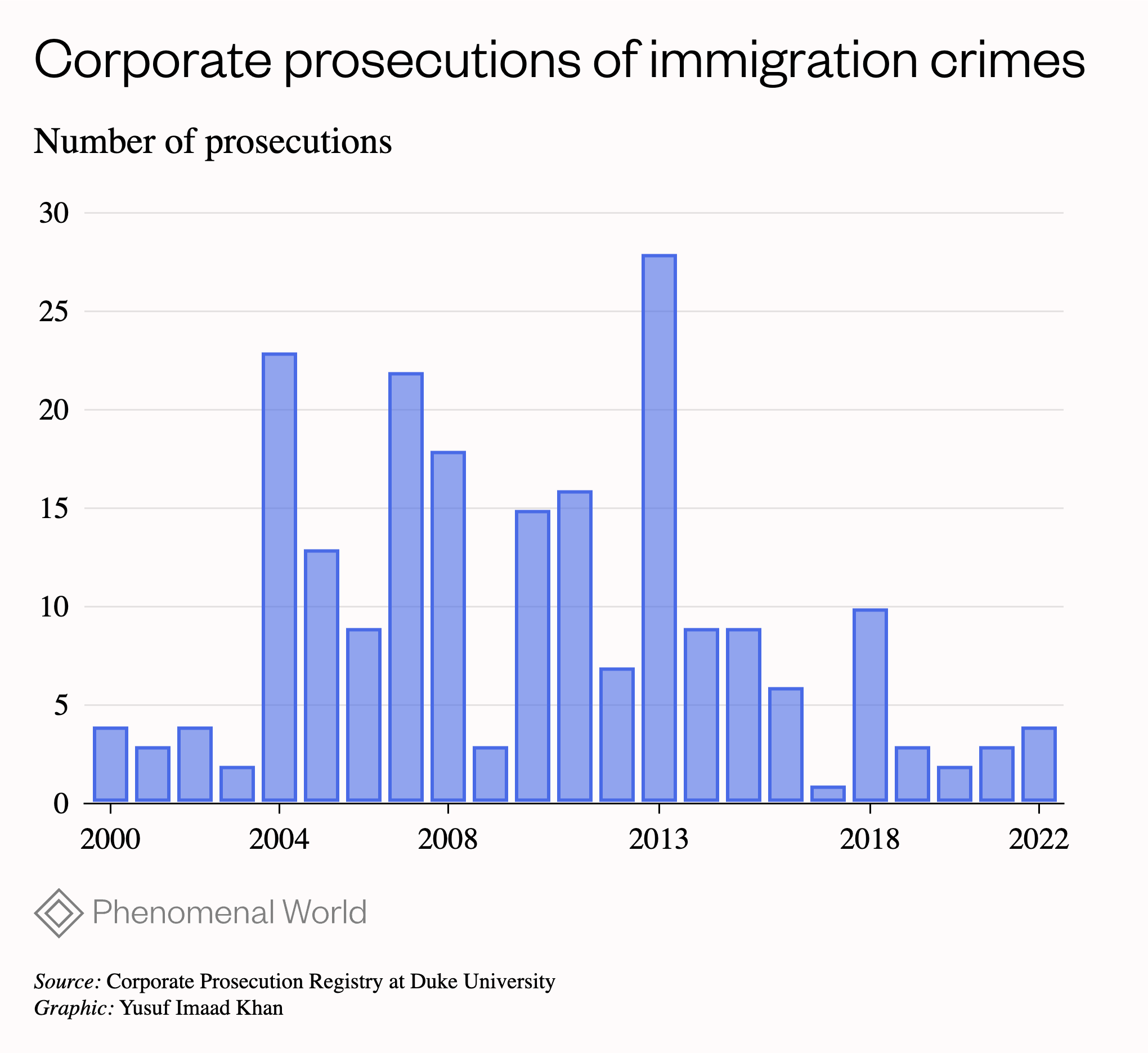
The root cause of illegal immigration is neither a lack of border walls nor ICE agents but rather employer demand. Yet Washington has consistently refused to hold employers accountable to the fullest extent of the law. In a landmark analysis at Phenomenal World, Michael Macher found that corporate prosecutions of immigration crimes have rarely exceeded fifteen annually (per data from Syracuse University’s Transactional Records Access Clearinghouse and Duke University’s Corporate Prosecution Registry). Immigration-related worksite investigations currently sit near a record low, with worksite arrests skewing overwhelmingly towards employees over employers. As Macher writes:
The U.S. immigration system runs not on the enforcement of immigration laws, but on their selective non-enforcement. Employers have relied on the state to ignore the exploitation of undocumented labor while holding the credible threat of deportation over workers. This has had the effect of strengthening employer bargaining power generally against all workers—lowering wages, weakening unions, and shifting the politics of work away from collective bargaining and wage-and-hour regulation. The interest in labor that is weak and disorganized has driven U.S. politicians, consciously or not, to adopt the role of petty bosses, threatening the deportation of significant portions of the U.S. workforce.
Routine amnesty for illegal immigrants—as just occurred in Spain—is moral to the degree that it formalizes the lives of individuals who are undocumented. Labor restrictionists, however, are also correct that it encourages further illegal immigration, perpetuating a broader system of mass exploitation benefitting “millionaires, billionaires” and credentialed professionals that employ undocumented maids, nannies, and landscapers.
Conversely, nativists’ ongoing performative, costly, and sadistic attempt at deporting every last illegal immigrant is ultimately ineffective and empowers mass migration advocates. In 2008, current Republican Kansas Attorney General Kris Kobach made a compelling case against a Gestapo-style deportation effort, arguing that it would be cheaper and more efficient to punish employers of illegal labor under a rigorous, national regime of E-Verify; predictably, Kobach has not held a formal position in either of Trump’s administrations, although he did offer advice on immigration during the 2016 transition.
An electronic verification system of employees’ immigration status created in 1997, E-Verify, as previously suggested, has been actively sabotaged at the state and national level by carveouts as well as poor and selective enforcement resulting from employer lobbying. Given sufficient political will, closing loopholes and stiffening enforcement would cost just over $600 million over the next five years under Kobach’s proposal compared to Trump’s 2025 $85 billion ICE budget. Illegal immigration by economic migrants would drastically decline in the long term, and large numbers of recent arrivals would self-deport for lack of employment options. An effective populist president could campaign on punishing employers that undercut native labor and subject undocumented workers to abysmal conditions.
While eminently desirable, a strict, national regime of E-Verify would still fail to eliminate the totality of an undocumented underclass. Longtime illegals—particularly spouses and parents of U.S. citizens—are unlikely to self-deport regardless of enforcement. Even at current rates of removals, moreover, it would take at least two decades to deport all undocumented thought to be in the country. A one-time pathway to citizenship for longtime undocumented thus becomes the most practical and moral remedy. Once again, however, any pathway to citizenship is ultimately counterproductive in the long term without including overwhelming penalties towards those who employ illegal labor.
In effect, the current iterations of the MAGA right and progressive left merely act as shock troops for a regime of mass exploitation. Some progressives argue that the solution instead is to grant status to every illegal upon entering the country. This, however, ignores other grievances from workers and legal immigrants towards illegal immigration, including strains on services and circumventing the formal immigration process. Indeed, the following section illustrates the shortcomings of a variation of this proposal.
Defending Asylum by Embracing Deportation
The modern asylum system in Western countries traces back to the end of World War II. Prior to and during the war, many refugees fleeing the Axis powers, including Jews, were returned to their countries of origin where they were ultimately put to death. Amid post-war concern for the plight of refugees, Article 14 of the UN’s Universal Declaration of Human Rights established:
1. Everyone has the right to seek and to enjoy in other countries asylum from persecution.
2. This right may not be invoked in the case of prosecutions genuinely arising from non-political crimes or from acts contrary to the purposes and principles of the United Nations.
In the United States, asylum was subsequently established as applying to claimants of five protected classes: race, religion, nationality, political opinion, or membership in a specific social group. Some courts have expanded their interpretation of these classes to include those fearing reprisal from criminal groups such as gangs and drug trafficking cartels.
The issue beginning in the neoliberal era of free-flowing goods, capital, and people is that increasing numbers of economic migrants have since sought to fraudulently claim asylum in the hopes of settling in countries throughout the Global North. Negative attitudes towards immigration across a host of developed countries are strongly correlated with concurrent spikes in asylum claims and illegal immigration. Relatedly, most countries also experience backlash towards low-skilled legal immigration. On the latter, the U.S. was comparatively tolerant towards mass, low-skilled, legal immigration—with the exception of conservative Republicans—up until recently.
Like America’s peers, however, illegal immigration has been consistently unacceptable to a majority of voters for the past two decades (even in March 2025, Gallup found 63 percent of Americans saying they were personally worried about illegal immigration a great deal or a fair amount). Progressives instead gravitated towards the foolhardy solution of legalizing illegal immigration through open asylum. In the 2020 cycle, nine out of ten candidates in the Democratic primary pool pledged to decriminalize border crossings—a position that more or less became government policy when Biden assumed the presidency in 2021.
An overly generous interpretation of asylum law allowed virtually anyone who arrived at the U.S.-Mexico border to claim persecution and stay within the U.S. over a course of years while their claim was processed. The result in equal measure was mass human trafficking and mass asylum fraud. Removals at the southern border jumped to record highs under the pandemic-era Title 42, though in some cases, many such deportees solicited a later entry via the “CBP One” app for an asylum screening.
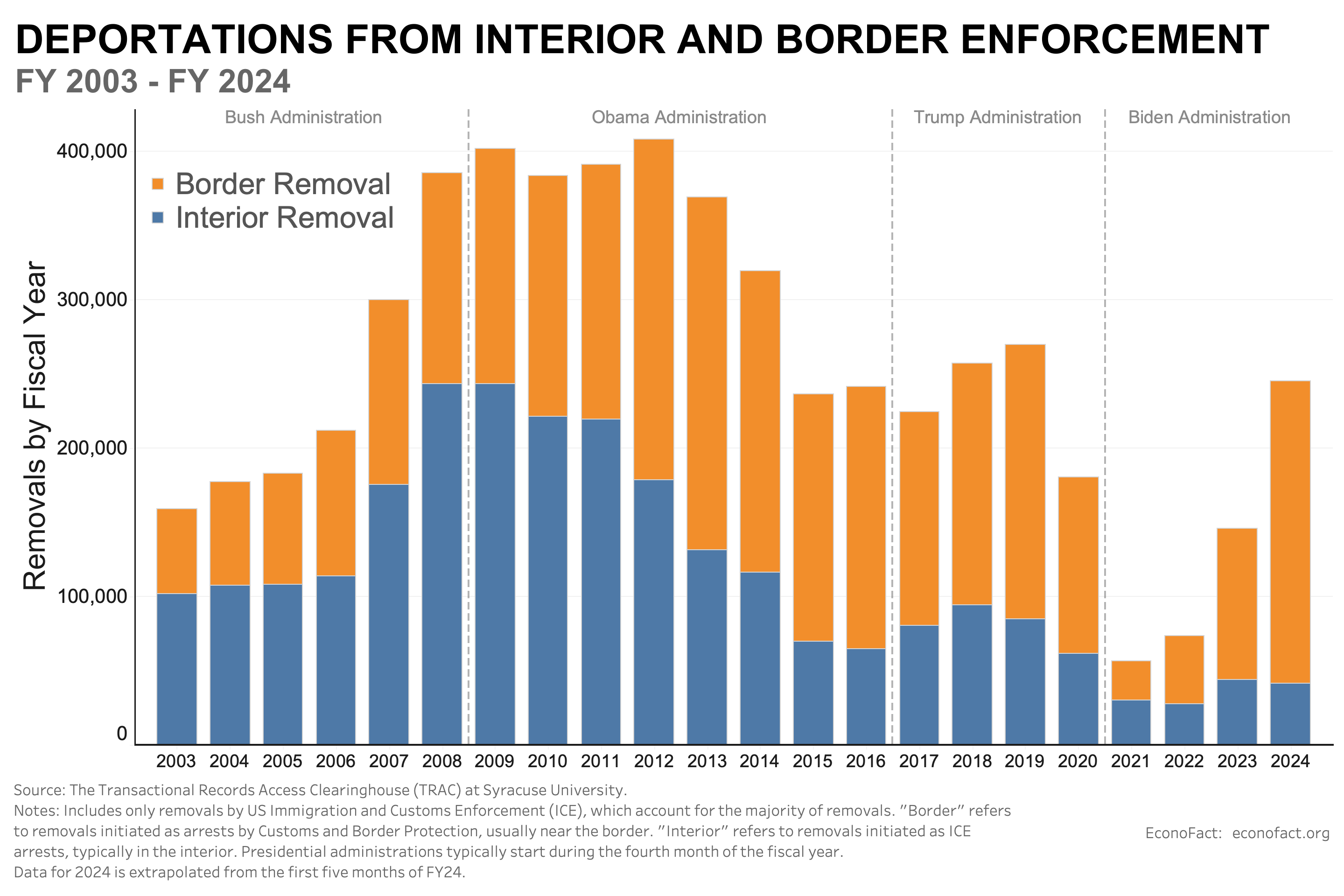
The problem, moreover, was that new arrivals—whether through an asylum claim or otherwise—ran virtually no risk of deportation once inside the country. Under Biden, removals from beyond the U.S.-Mexico border fell below 50,000 a year compared to around 100,000 a year under Trump and 200,000 a year during Obama’s first term. Considering that the number of immigrants without legal permanent status grew by at least 8 million, it’s fair to describe the former administration’s posture towards interior enforcement as one of utter dereliction. During Kamala Harris’s now infamous visit to Guatemala in 2021, she may as well have told migrants, “Don’t come (but if you make it past the border, we won’t deport you.)”
While it’s hard to say exactly how many asylum claims are fraudulent due to the politicized nature of the issue, defenders should note that Senator Rubén Gallego found cases of abuse reported by his Latino constituents to be compelling. Having worked as a social worker in immigration under Biden and conducted interviews with migrants in the Darien Gap, I myself found that the vast majority of claimants I interacted with lacked a credible fear of persecution in their home countries.
Progressives contend that the only remedy needed for Biden’s border policy was hiring additional judges to process a multi-million-person backlog of asylum claims. While it’s certainly true that more judges would have benefitted the backlog, the problem—as shown—is that fraudulent claimants faced, at best, a dubious risk of deportation. The obvious reason for this is that many Democrats, and especially progressives, consider interior enforcement of noncriminal undocumented to be illegitimate. Consequently, many restrictionists of all stripes now advocate for revoking the right to asylum outright—in practice this is currently the case save for white South Africans.
If Democrats wish to preserve asylum, they must be willing to subject the process to limits with penalties for fraud—meaning deportation. In June of 2024, Biden issued an executive order barring migrants from soliciting asylum after daily border encounters exceeded 2500 per day. This sensible measure decreased border crossings by 80 percent yet wasn’t campaigned on due to a progressive outcry over “fascism.” What critics failed to comprehend is that stiff interior enforcement ultimately helps asylum seekers. If economic migrants believe that they are certain to be deported for fraudulently claiming asylum, total claims necessarily fall, benefiting claims by actual asylees. As it stands, the 2024 limit set by Biden still translated to roughly pre-pandemic levels of yearly border crossings.
An apt complement for a more credible asylum regime is the “Remain in Mexico” policy as well as other “Safe-Third Country” agreements from the first Trump administration. The former forced asylum seekers to process their claims in Mexico before entering the U.S. while the latter encouraged them to first submit claims in respective third countries. MAGA 1.0 was, in fact, correct that international law stipulates that refugees should apply for asylum in the first country they flee to.
Conversely, MAGA 2.0 and progressives are respectively incorrect that the entirety of Mexico is a cartel wasteland unsafe for asylum seekers and in need of military intervention; ironically, strikes would produce a torrent of actual refugees at the border fleeing American bombs. Numerous states and cities across Mexico including the capital, Puebla, Nuevo León, and Monterrey are relatively safe and host to millions of foreign expats, tourists, and international immigrants. Asylum seekers have previously waited out claims in metropolises like Mexico City or elsewhere before traveling to the U.S. through a safe, legal point of entry; a portion of claims could likewise be processed in each country. Here, close cooperation, mutual respect, and benefit for both countries would be vital.
A broader conversation on asylum reform should be had on the center-left. Above all, it must be acknowledged that no asylum or immigration system can possibly be expected to function without a credible threat of deportation. Many progressives currently championing abolishing ICE are performing a sleight of hand that deliberately obfuscates the role of deportation in a hypothetical post-ICE future. Deportation should be neither deliberately cruel nor ignore migrants’ constitutional rights to due process. Yet as former representative and civil rights icon Barbara Jordan once argued, “For the system to be credible, people actually have to be deported at the end of the process.”
Immigration in the National Interest and Development Abroad
The broader purpose of immigration should not serve corporate, family-based, or ostensibly humanitarian interests but instead serve the flourishing of workers. To that end, a points system prioritizing skills, language, and education should take precedence over family reunification. While conservatives obsess over the culture of many Catholic, Evangelical, and frequently neoconservative Latinos, the evidence shows that Latin American, Asian, and even Middle Eastern immigrants are assimilating at comparable rates to prior waves of European immigrants. This stands in stark contrast to many countries in Western Europe, where concerns over cultural differences and many immigrants’ lack of assimilation are well founded.
Nonetheless, it’s abundantly clear that decades of historic, low-skilled, legal immigration have fed a strong nativistic current within the modern Republican Party. It should be noted that neighboring Canada has experienced a higher proportion of overall immigration than the U.S. under a points system and airtight regime eliminating employers’ ability to contract illegal labor. Yet no comparable nativism exists within any of the country’s major political parties. A points system in the U.S. should likewise end the current model of employer-sponsored immigration. The use of H1B and H2A visas is effectively a form of indentured servitude where, as with the undocumented, the tacit threat of removal is a vital mechanism of coercion over workers; last week, the Trump administration announced it aims to double issuance of H2As for 2026.
Finally, Democrats should seek to stem emigration in migrants’ home countries by partnering with leaders that champion job creation, workers’ rights, and national development. Leaders such as Mexico’s Andrés Manuel López Obrador (AMLO) and Claudia Sheinbaum have promoted poverty alleviation, wage increases, unionization, and infrastructure improvements under a sound framework of fiscal responsibility. As a result, Mexican emigration has fallen to record lows in the past decade after soaring during the 1990s and 2000s.
Sheinbaum has even proposed expanding the Yucatán peninsula’s 966-mile Maya Train into Central America in the hopes of creating jobs and fueling investment in Mexico’s disadvantaged southern neighbors. Democrats would do well to reexamine the Kennedy administration’s Alliance for Progress. Rather than the microcredit startups peddled by today’s NGOs, the initiative once sought to deter communism through the promotion of labor and development in the spirit of the American System. Both admirers of “New Deal” America, AMLO and Sheinbaum lauded the Alliance for Progress and have called for a similar proposal in the region.
An Endless Cycle of Cruelty and Exploitation
Ask any progressive how much influence they exert within the Democratic Party, and they will regale you with tales of impotence and betrayal by a hostile centrist elite. While it’s certainly true that leadership has routinely sabotaged popular proposals like raising the federal minimum wage and creating a public option for health care, progressives have dominated Democratic policy on energy, public safety, and especially immigration—with catastrophic results for workers.
For all their talk of class politics, progressives consistently omit class as a lens for analyzing attitudes toward immigration. Non-college workers are more likely to view high levels of low-skilled and especially illegal immigration as a detriment to social cohesion, straining benefit programs and schools, and increasing competition for housing and blue-collar jobs. In contrast, college-educated professionals are more likely to view mass, low-skilled, and illegal immigration as enabling cosmopolitanism, atoning for past wrongs in the Global South, and offering a cheap source of informal labor. The cold, hard truth about the Democratic surge in indifference towards illegal immigration is the fact that large numbers of non-college workers have left the party.
Democrats must embrace an immigration agenda that diminishes the issue’s electoral importance and alienates credentialed elites in favor of non-college workers.
The party is likely to make gains against a GOP that is increasingly championing extreme nationalism and “blood-and-soil” politics. Simply winning by default, however, is almost equivalent to not winning at all. Worse, a reversion to a quasi-open borders policy will only deliver further cruelty and exploitation towards the undocumented at the hands of another, future nativist administration. Barring reform, the continued casualties of employer greed, self-righteous cosmopolitans, and nativist sociopaths will be workers and illegal immigrants.
Juan David Rojas is a journalist specializing in U.S. and Latin American politics. He is a frequent contributor to Compact, The Liberal Patriot, and American Affairs.
Just remember that Martha’s Vinyard had 50 illegal immigrants and they were gone in 48 hours by military evacuation.
The left believes strongly in the morality of open borders, and equally strongly that illegal immigrants need to be quarantined in poor neighborhoods—far away from their lily white progressive enclaves.
I think it's currently impossible for the Democratic Party to do anything about our immigration problem, the Democratic Party is the problem.
Currently Trump and the Republicans are trying to fix what we mostly did. To be credible we should try to assist Republicans, admit that we made a horrible mistake, apologize to all the workers both American and illegal affected, and do all we can to assist in fixing things.
There is a $2,600 stipend for those who self deport. Per person. For a family of four that's $10,400. I bought land and built a fourplex in the third world with $6,000. I'd think ten thousand is more than enough for many to get a new start.