



We’ve documented numerous times the collapse of voter trust in government and public officials, a problem that has only intensified as national politics turns ever more polarized and dysfunctional. New data from YouGov shows that in early 2026, there are only two agencies in the entire federal government that most Americans say are trustworthy—the National Park Service (NPS) at 57 percent and the National Aeronautics and Space Administration (NASA) at 52 percent. The National Oceanic and Atmospheric Administration (NOAA) and the Social Security Administration (SSA) are viewed as trustworthy by more than four in ten Americans, and the rest of the agencies on the list receive paltry trustworthiness marks.
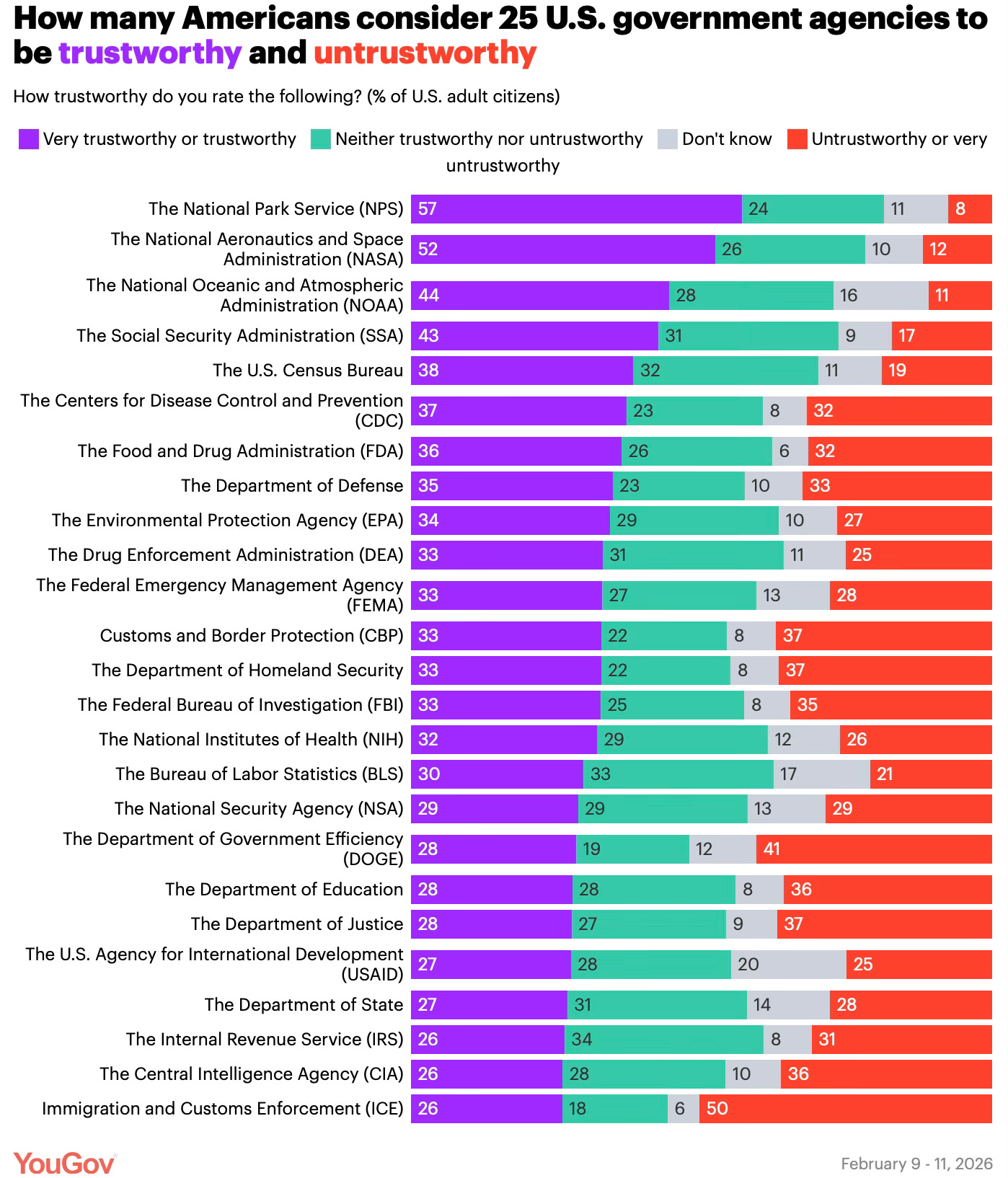
Parks and rockets are the only two government functions that Americans reliably trust, along with some minor love for weather reports and support for the elderly and disabled. That’s it.
This is a truly pathetic situation that goes well beyond partisans yelling, “It’s Biden’s fault!” or “It’s Trump’s fault!” Years of neglect and incompetent management by both parties have left Americans across the divides deeply distrustful or uncertain about the trustworthiness of the public sector in areas ranging from health and education to justice and national security.
Partisans, of course, have their favorites and least favorites: e.g., Democrats are much less trusting of ICE, DHS, CBP, the Pentagon, and the Justice Department than Republicans, while Republicans are much less trusting of USAID, the EPA, and the CDC than Democrats.
But beyond the expected dislike of certain government functions that don’t fit each party’s respective ideological biases, it’s much more concerning that Americans overall don’t seem to trust much of anything carried out or released by the government, even basic information. Other data highlighted by YouGov shows that only 23 percent of U.S. adults believe that all or most of the statistics reported by the government are “reliable and accurate”—down from 36 percent just a year ago. Similarly, if you look at the chart below, you’ll see at most only around one third of adults deem a range of specific government statistics from population counts to crimes to the number of COVID-19 deaths to be trustworthy information.
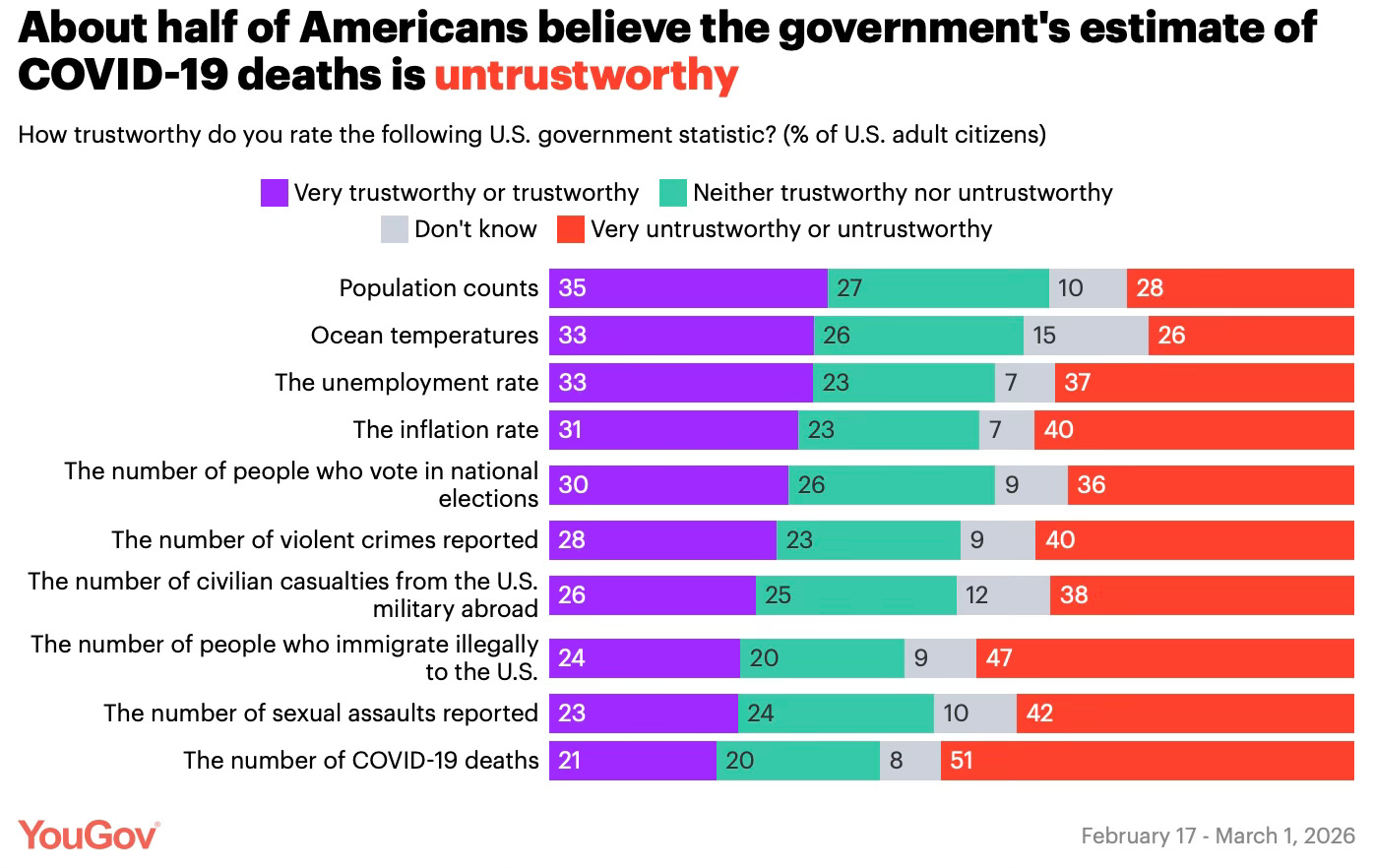
Although there are expected partisan divides on many of these measures given who is in power at any given point, the much bigger question is whether government in the public interest is even possible anymore—at least in terms of whether Americans themselves will ever again view its work as reliable, trustworthy, and valuable independent of who is in charge.
My guess is that most Americans respect and value the hard work and dedication of those civil servants who help keep our country safe, clean, healthy, secure, prosperous, well-educated, and orderly. Sure, there are constant hits on layabout bureaucrats and “government fraud,” with many of these complaints being legitimate grievances, but the work of the public sector and government agencies is often grueling, underpaid, and subject to constant whiplash by wealthy members of Congress and presidents trying to score political points.
Federal workers do the business of the American people mostly well and mostly without complaint. We need genuine leadership from the legislative and executive branches to back up these workers and ensure that the activities and services of the federal government are unmatched in their excellence. The government should never settle for mediocre services or throw up its hands and say the system is what it is and can’t be fixed. The government should aim higher to achieve the levels of public backing and support that many private sector companies receive from Americans based on the quality of the services and products they supply—and their responsiveness to consumers. This will require far more transparency from government agencies plus constant internal reviews and upgrading of techniques and methods used to carry out the people’s work.
Likewise, Congress should pay its bills and stop using shutdowns of agencies and threatened defaults to make meaningless ideological points. We’ve had two federal government shutdowns in a mere six months, basically for no reason and no discernible outcome other than partisan spite. Programs and agency budgets that are superfluous or out-of-date should be eliminated through the legislative process, and money saved should be used to reduce deficits or shifted into other proven projects that people need to live a good life or get ahead.
Finally, vital information released to the public on the state of the economy or our overseas commitments or public health or national emergencies must always be viewed as truly neutral facts and advice, entirely free of partisan interference by outside political actors trying to defend their positions and from internal managers trying to achieve some ideological goal. If public officials can’t or won’t adhere to these standards, they should be promptly removed and replaced by others who will.
America is a fantastic nation that faces an array of manageable economic and security challenges that can be overcome if we put our minds to the task more cooperatively and end the ridiculous partisan degrading of the public sector. We need a federal government and workforce better managed and operated and ready to work in partnership with private businesses and civil society to keep improving the lives of all Americans and maintain a robust national economy.
If politicians in the two parties would rather preen on social media than work in concert to help build a high-functioning governmental system, then they should retire from public life or expect to be voted out by citizens and replaced with officials genuinely interested in making government work better for the people.
When it comes to the federal government, trust is a one-way street. The government must earn the trust of Americans, not expect them to go along with shoddy services, poorly designed programs, and surly or entitled attitudes from politicians.
Federal authorization is limited to about five enumerated powers. All else is overreach and extraconstitutional. Beyond those five, additional nanny statism should be limited to thst voted by the people locally or in the individual states. Government positions are overpaid and benefits are ridiculous. Too often the roles are nothing more than workfare filled by unqualified DEI hires. You wonder why we don't trust government? Have you ever had to work with any agency at any level? Born free, taxed to death.
I cannot say I am surprised. If anything, I am surprised that trust in institutions like the FDA and the CDC is as high as these numbers. The previous gang at the Biden FDA and CDC lied so consistently throughout the Covid years that I can only assume there are a lot of very stupid Americans. And as it is becoming clearer that most social safety net programs are rife with fraud on an industrial scale, trust in those programs is going to evaporate as well.
Part of the problem is that Democrats seem to be unwilling to even contemplate programs that might rebuild trust. Their first (and often only) response is to scream "nothing to see here; move along!" I am not much of a conspiracy person but I have reluctantly come to the conclusion that voter fraud must be a significant problem given how fiercely Democrats are fighting even the most banal of proposals. Everybody in the USA has ID of some sort and everybody has fingerprints and a biometric unique identity. So come up with a reasonable set of rules that make it no harder to vote than to buy alcohol and cut a deal. If Americans cannot trust that the voting process is legitimate, it is hard to have any trust in government.