



As the Trump administration has ramped up ICE activity across the country, many Americans, especially Democrats, have grown outraged by the perception that ICE is acting with impunity and fearful that events like those playing out in Minneapolis illustrate the country’s slow decline into authoritarianism—feelings that are not without merit. Democrats believe Trump is no longer moored by legal constraints and just does whatever he wants, and they are desperate to check his power and exercise some oversight of the agency.
At this moment, when emotions are running high and America feels like a tinderbox, it’s crucial that the party think clearly about the long term and for reformers to be strategic about how they address these issues. Unfortunately, some are instead embracing the short-term catharsis of a familiar slogan: “Abolish ICE.”
Most high-profile party figures agreed not long ago that this idea was a political loser. In the 2018 midterms, few actual Democratic politicians endorsed the policy, making it hard for Republicans to attack them with it. In the 2020 presidential primary, just two candidates supported abolishing the agency: Bill de Blasio and Bernie Sanders. But as ICE has become more present in daily American life and its tactics have grown more controversial, the slogan is creeping back into the liberal mainstream—promoted by politicians and pundits alike.
It’s not just the party elite, either. One tracking poll shows that the share of Americans who support the idea has increased considerably since the start of 2025 and currently sits at an eight-year high of 42 percent. Some of this has been driven by independents (going from 25 percent in January to 42 percent today), but the lion’s share of the shifting support has been from Democrats, going from 40 percent the day Trump was inaugurated to a massive 69 percent today.
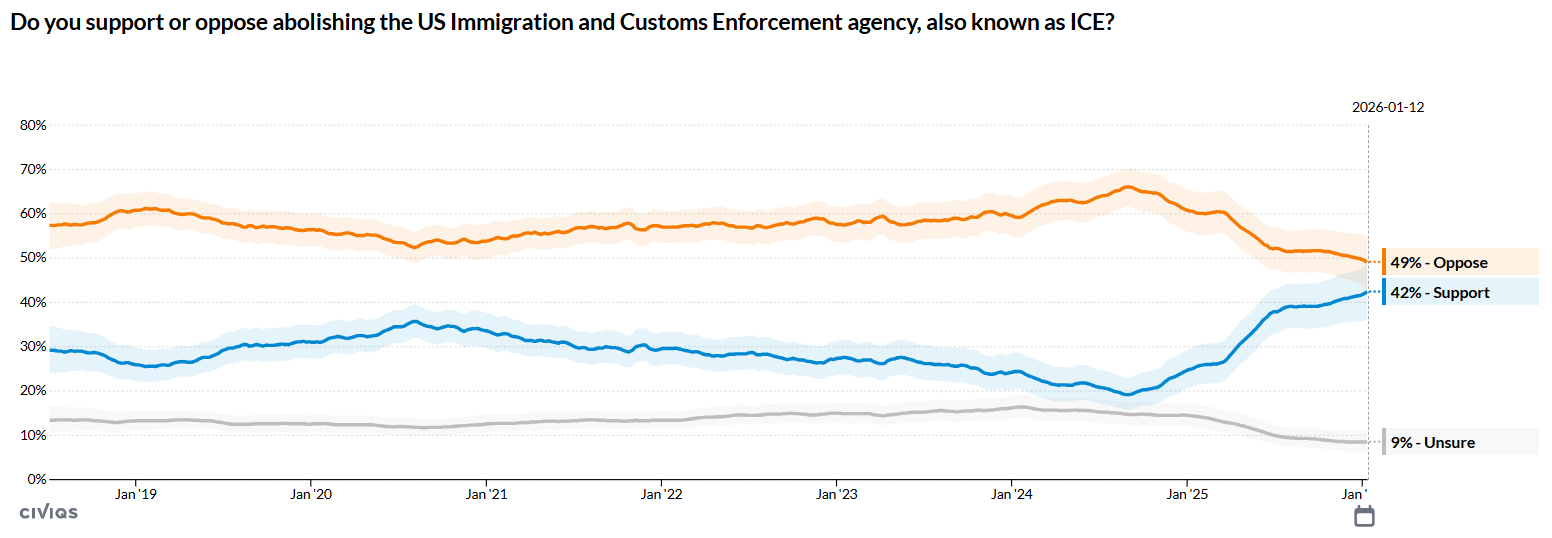
Of course, it is possible that this poll overstates actual support for abolishing the agency. Some people, for example, could be engaging in what pollsters call expressive response, a phenomenon wherein people give survey responses that are more partisan than their actual beliefs. For many, politics is at least in part about fitting in, and one’s endorsement of slogans like this could be due to peer effects. Some of this could also be thermostatic public opinion: voters react (often negatively) to changes in government policy like a thermostat, shifting against whichever party is in power and their agenda.
Still, it’s a good bet that this mantra will not fall out of favor among many liberals anytime soon, that more of them will in fact become receptive to it, and that Republicans will use it to paint Democrats once again as extremists in the lead-up to this year’s midterm election. Though Democrats are well positioned to win back power this November for a number of reasons, the proliferation of this sentiment in the party—even just among its base voters—could introduce an unnecessary risk to its effort to win back power and offer a real check on Trump.
The most obvious risk would be in districts and states that broke for Trump in 2024 and that Democrats need to win to flip the House and especially Senate. Take Ohio, where former Democratic Senator Sherrod Brown is running again and where Trump won by 11 points last time. A December poll found that a majority (53 percent) of voters in the state “think mass deportations of undocumented immigrants in Ohio are a good thing for the state.”
Facing headwinds in this election, Republicans won’t hesitate to use the activist slogan as a cudgel against Brown or other candidates running in red states like Mary Peltola in Alaska or James Talarico in Texas. It could be more effective than in the past given the increasingly national nature of American elections. Even if candidates in these places try to run relatively moderate campaigns, it may be harder to outrun the party nationally and the criticisms or perceptions people have of it. And without capturing at least two of these Trump-leaning states, Democrats have no shot at winning back the Senate this year—which means, among other things, that they would have no power to check Trump’s judicial or cabinet appointments.
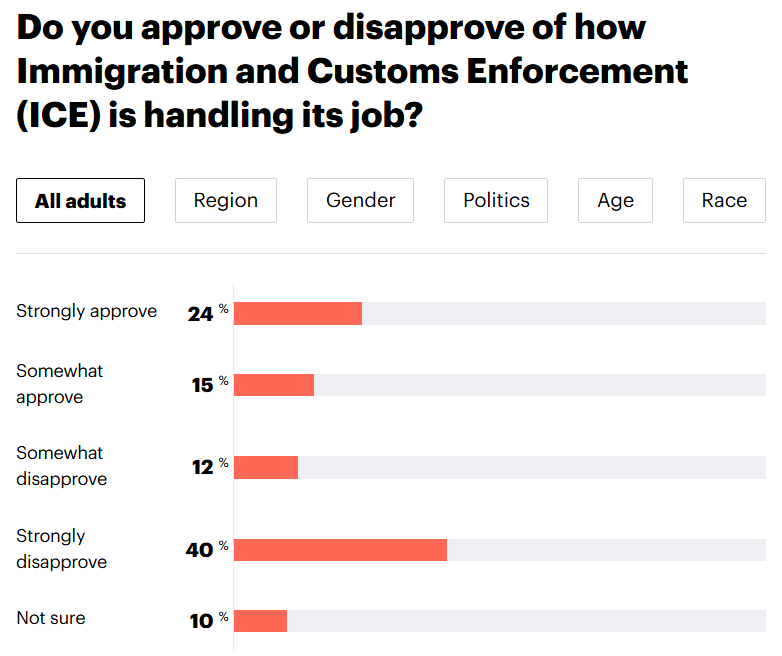
None of this, however, means that Democrats can’t or shouldn’t talk about ICE and its actions. It is true that Americans’ disapproval of ICE is climbing: according to polling from YouGov, the agency’s net approval was +16 as of last February, but today it sits at -13, with fully 40 percent of Americans now “strongly disapproving” of their job performance.
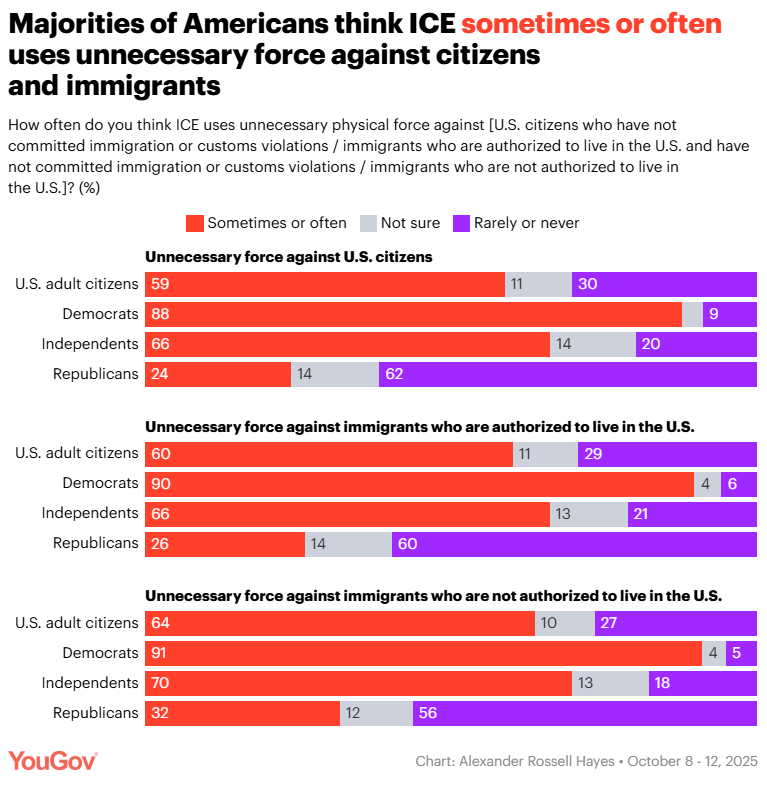
A November poll, also from YouGov, found that a majority of Americans (52 percent), including 60 percent of independents, say ICE’s tactics are “too forceful” (compared to just 11 percent who argue they are not forceful enough and 26 percent who said they are “about right”). Even larger majorities believe ICE uses “unnecessary force” against U.S. citizens, immigrants authorized to live in the U.S., and even immigrants who are not authorized to live here.
At the same time, the public still doesn’t totally trust Democrats to deal with the immigration issue. In a survey from the center-left think tank Third Way last fall, voters in swing districts trusted Republicans more than Democrats to handle border security by a margin of 56 percent to 36 percent. This is likely due to lingering frustrations over President Biden’s border policies. Americans aren’t totally against deportations, either: a majority—including 55 percent of Latinos—say that at least some immigrants living in the country illegally should be deported.
Rather than embracing “abolition,” historically a polarizing and risky idea, Democrats would be wise to focus instead on “accountability.” Immigration enforcement is a necessary job, but both ICE and the Department of Homeland Security have gone way beyond their mandates. Accountability for them might include greater House oversight of Todd Lyons and Kristi Noem and more stringent conditions on the department’s budget. It may even entail expelling the worst (or least qualified) of the agency’s new hires. If Trump’s 2024 victory and second term have shown anything, it is that Americans right now are very open to holding government institutions more accountable. No agency or department is above scrutiny, including ICE and DHS.
However, promising more oversight must go hand-in-hand with providing a real plan to address Americans’ continued concerns about immigration enforcement. Part of the reason many of them likely don’t take Democrats seriously on these issues is because they don’t believe the party is serious about enforcing immigration laws—a perception that didn’t come from nowhere. There is an opening here for the party to gain back lost ground and rein in the excesses of Trump’s deportation policies. But they must be smart about how they approach it, and not succumb to their emotions or the trendy rallying cries of the moment.
Editor’s note: a separate version of this piece was first published on UnHerd.
I also think that the sanctuary cities whose police force are not allowed to cooperate with ICE are part of the problem. At the very least an illegal immigrant who has been convicted of a crime should be reported to DHS. Also those with deportation orders already … but maybe this is by design to make ICE look bad?
Some ICE agents have definitely been too aggressive, even illegal, in their interactions with civilians. But the reason that opinion polls show declining public support is that the non-conservative media - that’s almost the entire legacy media - have been completely one-sided in their coverage of ICE activities. ICE is always shown in negative ways, but there is rarely even slight mention of the thousands of violent criminals that ICE has apprehended. I live near Minneapolis and the recent ICE surge has resulted in ten convicted murderers and dozens of other violent criminals taken into custody. I’m not aware of any legacy media outlet disclosing that fact.
As for the political angle, any Democrat who hopes to get or stay nominated for elective office must be vocally anti-ICE, as in ICE should be abolished or do little to no enforcement of immigration laws. The crazed Left controls Democratic primaries. The bottom line is that Democrats are now pro-open borders and they won’t moderate - period.