


As 2025 comes to an end, all eyes in the world of politics now turn to next year’s midterm elections. Currently, things are shaping up well for the Democratic Party, as they typically do for the party that doesn’t control the presidency. Among the issues that may help propel them back to power in Congress and downballot is the cost of living. An issue that once drove Trump’s return to the presidency has become an albatross for him and his party.
Now, Republicans are set to pour lighter fuel on the situation. Congress has officially recessed for the holidays and did so without shoring up subsidies meant to keep costs under control for the roughly 24 million Americans who get their health insurance through the exchanges set up under the Affordable Care Act (ACA). Failing to extend those subsidies or offer some other reform to tackle the rising costs means premiums will increase for tens of millions of people at the beginning of the new year. Politico explains:
Premiums are set to rise by 26 percent on average next year, according to an analysis from the health research organization KFF, and the loss of the enhanced credits would mean consumers have to devote more of their income to health care costs. That means the out-of-pocket contribution from subsidized enrollees could more than double due to the loss of the boosted credits, according to KFF.
However, KFF added that most enrollees could see even steeper increases in what they pay than 26 percent:
This 26 percent is the increase in the amount insurers are charging, which in most cases is not what enrollees pay. 22 million out of 24 million marketplace enrollees currently receive a tax credit. The amount subsidized enrollees pay is not what insurers charge, but rather a sliding-scale share of their household income, based on a formula set by Congress. If Congress extends the enhanced tax credits, the amount subsidized enrollees pay each month will remain about the same, even though the amount insurers are charging is increasing sharply.
If the enhanced premium tax credits expire at the end of this year, KFF estimates that currently subsidized enrollees will see their monthly premium payments more than double, increasing by about 114 percent, on average.
At a time when Americans remain frustrated with the state of the economy and cost of living (something Trump seems well aware of), letting health care costs spike will only add to their stresses. Let’s take a look at the bigger picture—and at the political impact this could have on Republicans next year.
1. Heading into 2026, a greater share of Americans wants the government to prioritize health care.
New polling from AP-NORC asked Americans to list in their own words up to five issues they want the government to tackle in 2026. The economy was by far the top priority, with roughly seven in ten respondents mentioning at least one economic issue. But perhaps just as notably: 41 percent cited health care issues, up from 33 percent one year ago and putting it slightly behind immigration (44 percent).

The poll also found that Trump’s approval rating on health care sat at just 29 percent, which ties his lowest level in the poll’s history—December 2017, only months after his failed attempt to repeal the ACA.
2. More Americans are worried about health care costs than at virtually any other time in the last 25 years.
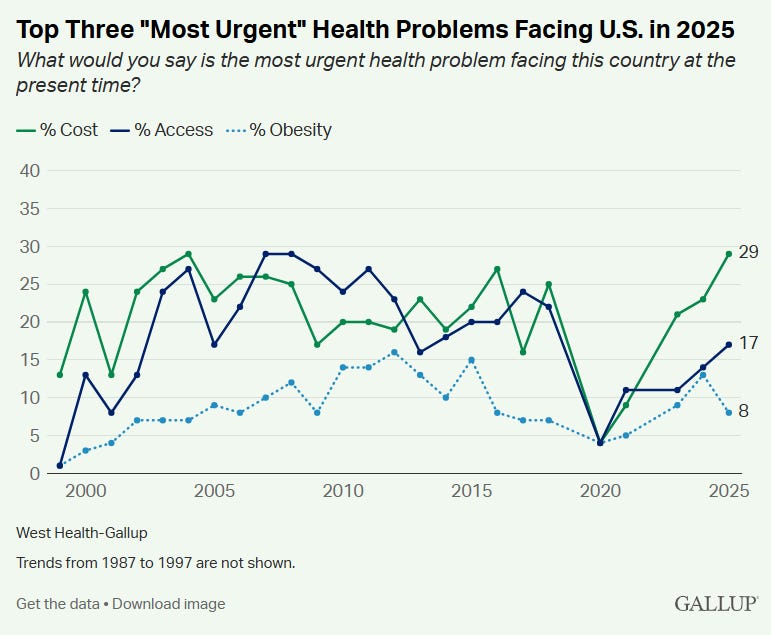
A recent Gallup survey found that 29 percent of Americans cite costs as the “most urgent health problem” facing the country, the most since 2004 and tied for the highest level this century. Access to health care was a distant second at 17 percent, followed by obesity at just eight percent.
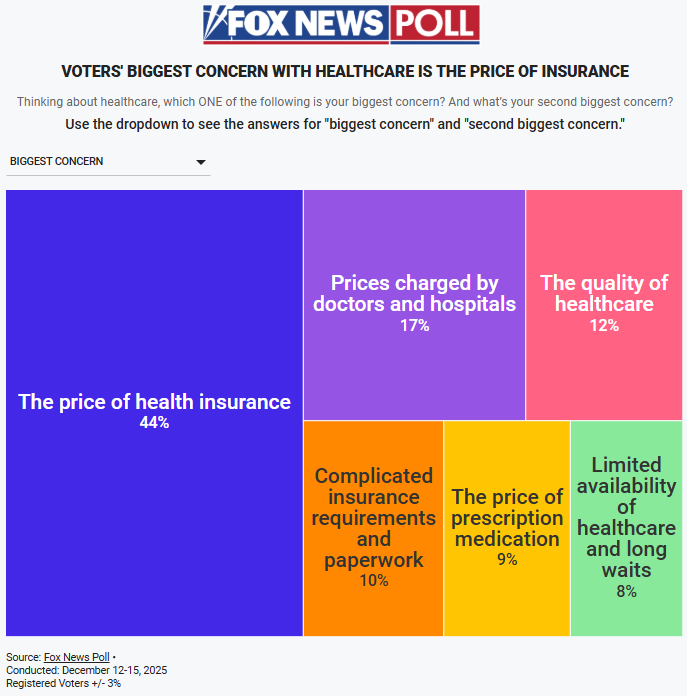
Similarly, Fox News reported that the share of voters saying they are “extremely” concerned about the price of health care hit 55 percent this year—a 17-year high—while another 30 percent were “very” concerned. When breaking down several different health care issues, a large plurality (44 percent) identified “the price of health insurance” as their biggest concern.
3. Millions of Americans with marketplace plans will either pay substantially more or lose coverage entirely if the enhanced subsidies expire.
Congressional Republicans have tried to soften the blow of forthcoming premium increases by arguing that the highest-income Americans would see the worst of it, which is correct. However, middle- and lower-income families will still be hit with substantially higher costs as well, and chances are they won’t be able to weather it as much as higher-income earners. Politico broke down how much monthly premiums will go up for Americans depending on their age and family status:
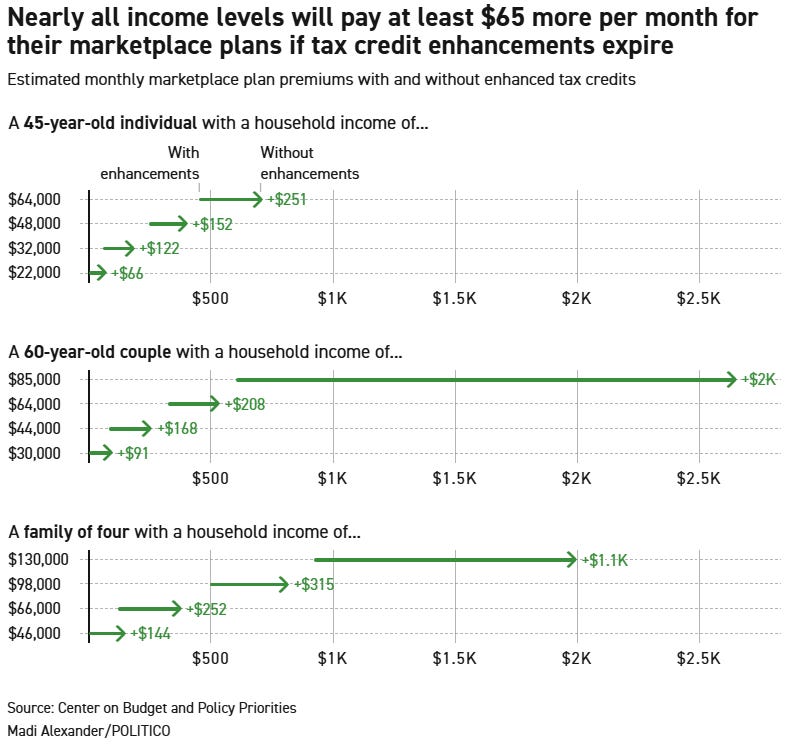
Even higher-income households may find it difficult to afford these spikes, but for those on the lower end of the income scale, higher costs could make affording health care nearly impossible—leaving them without coverage entirely. In fact, according to CBO estimates, roughly four million people are likely to lose coverage without the ACA subsidies.
4. Obamacare is more popular than ever before.
Despite starting out as a highly contentious policy, the ACA has only grown in popularity since is passage in 2010. Since December 2016, the public has maintained a net-positive view of the law, hitting record popularity in 2025 when 66 percent of Americans viewed it favorably against just 33 percent who did not. This included a whopping 71 percent of independents and even more than a third (36 percent) of Republicans.
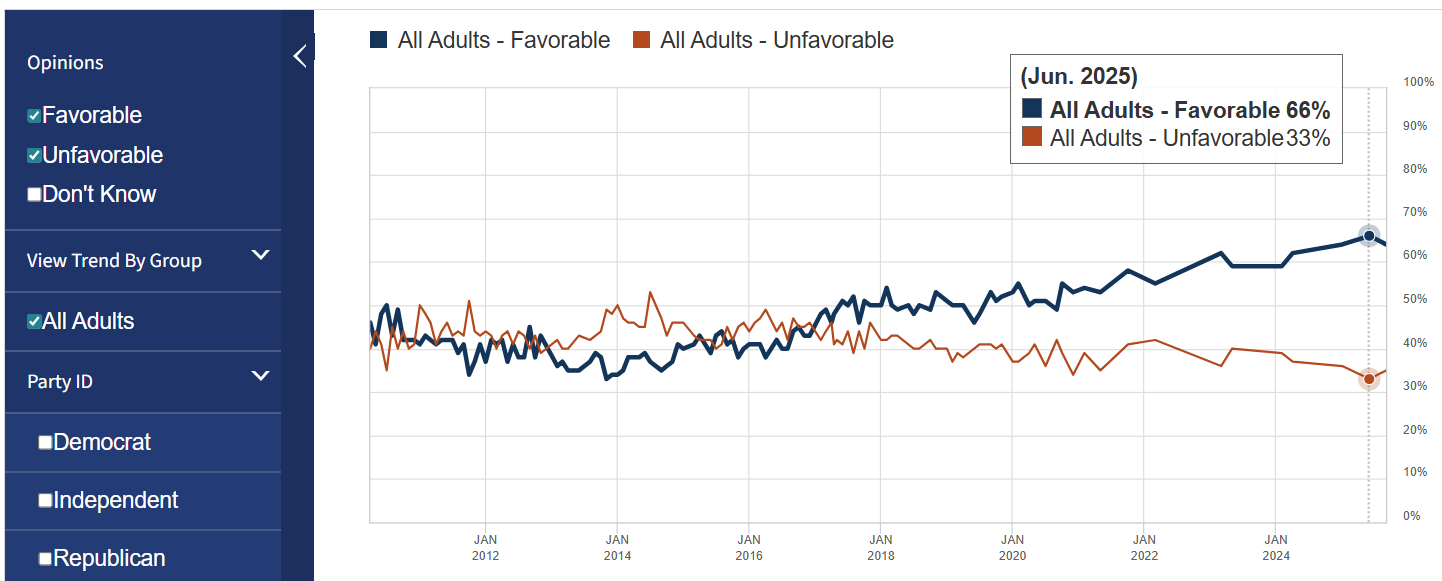
New Gallup polling confirmed this, finding that a record-high share of Americans approve of the ACA and, perhaps just as importantly, only 25 percent said they supported repealing the law, including a mere 17 percent of independents.
5. Medicaid remains popular as well.
Medicaid, which provides health insurance to nearly 80 million low-income Americans, is even more popular than the ACA. Fully 83 percent view the program favorably, according to KFF, the highest level since the beginning of Trump’s first term. This includes an identical share of independents and a massive 74 percent of Republicans (the latter of whose favorability has grown by 11 points from last year).
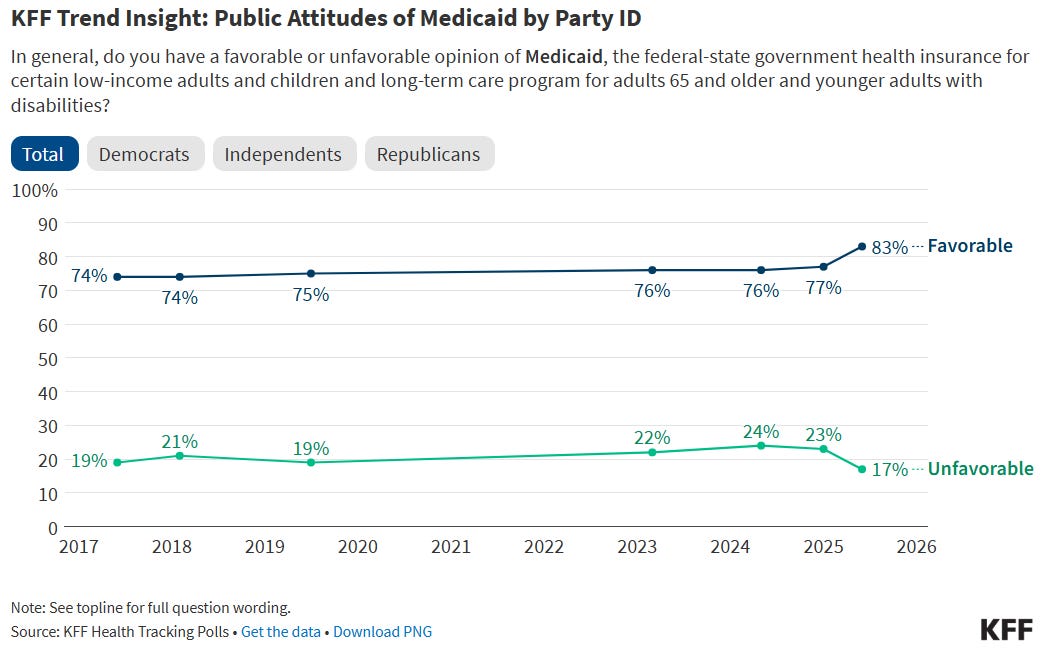
Following the passage President Trump’s One Big Beautiful Bill, an estimated 7.8 million Medicaid recipients could become uninsured. Combined with a higher premiums on the ACA exchanges, this could lead to chaos in America’s healthcare industry short of Republicans providing their own fix—and quickly.
6. Voters trust Democrats more than Republicans to handle health care issues.
Though Democrats are still working to earn back voters’ trust on a range of issues, they have consistently had an advantage over Republicans on health care. According to KFF, 43 percent of voters say they trust Democrats to do a better job of addressing the future of the ACA compared to 32 percent who say the same of Republicans. That gap was slightly narrower on the matter of addressing the high cost of health insurance but still favored Democrats, 39 to 33.

As the cost of health care becomes a more salient issue, Democrats appear poised to benefit. KFF asked respondents, “If your health care expenses increased by $1,000 next year, do you think that would have a major impact, a minor impact, or no impact at all on each of the following in the 2026 midterm elections?” Large pluralities said that it would have a “major impact” on their decision to vote (49 percent) and the party whose candidates they would support (46 percent), including a majority of independents.
7. Republicans will face blame if ACA premiums increase.
Recent polling shows that President Trump (41 percent) and Republicans in Congress (35 percent) will receive the lion’s share of the blame if Congress fails to shore up the ACA’s subsidies, a view held by 82 percent of independents, 64 percent of non-MAGA Republicans, and even one-third of MAGA Republicans.
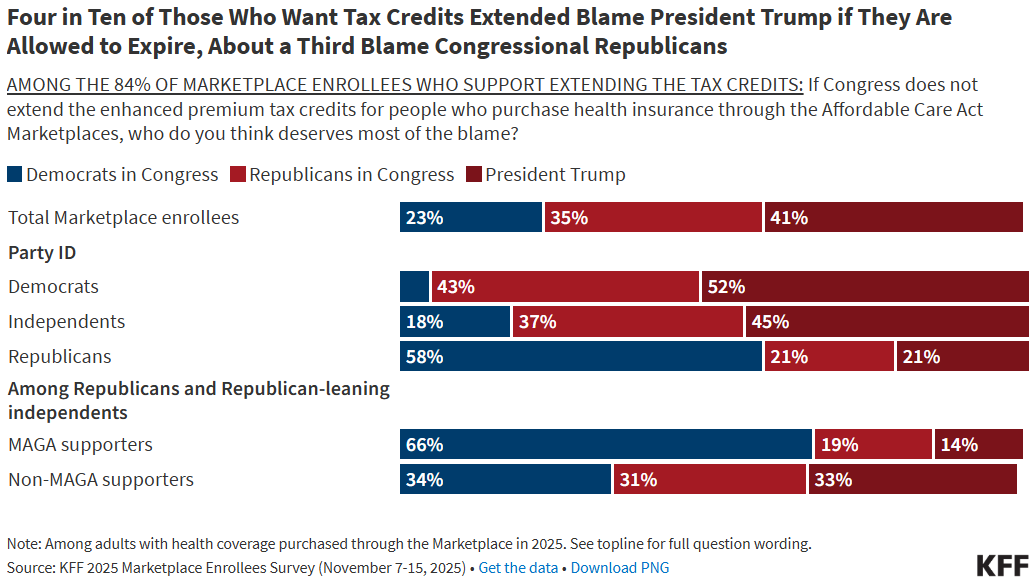
Democrats—especially those in battleground races—are highly likely to make health care a centerpiece of their campaigns, just as they did in 2018. It does appear that the growing salience of this issue is already working in their favor, as it has forced Republicans to divert their attention to an issue on which they are weaker. As Punchbowl News explained last week:
So in less than two weeks, millions of Americans will see a huge spike in their premiums or they’ll lose coverage as Congress goes over the Obamacare cliff. This plays into the growing economic fears felt by many Americans. President Donald Trump spoke to this issue in his Wednesday night address from the White House, although it’s clear Republicans are going to have to go a lot further than he did if they want to turn things around.
In fact, if you zoom out right now, congressional battles are being played, in large part, on Democrats’ turf. They have Republicans talking about health care. Johnson says House Republicans will spend a good chunk of next year on the issue, a topic on which the GOP is typically weak. Next month also will be about government funding and social programs, which again favor Democrats.
Will the health care issue ultimately boost Democrats? If the 2018 elections were any indication, there’s a strong chance it will. That year, 27 percent of voters—a plurality—identified health care as the top issue facing the country, and they voted Democratic by a margin of more than three to one (76 to 22 percent). In that same election, 41 percent of voters approved of Trump’s handling of health care versus 59 percent who disapproved, a gap that is markedly worse today.
It’s also important to remember that there were no fundamental changes to the healthcare system in Trump’s first two years. The GOP’s effort to repeal Obamacare came up short. And yet, just the threat of repeal proved to be a political liability for them.
Additionally, the economy was in far better shape then than it is today. Even within that context, Democrats made massive gains in the midterm election. If the ACA’s subsidies expire, not only will millions of Americans feel tangible effects as a result, but it will come at a time when their feelings about the economy are far worse than they were eight years ago.
It’s rarely wise to speculate about how things will evolve in the Trump era, and it’s impossible to know what the top issues will be for voters by next November. Republicans may also find a fix for these problems in the interim. But at present, they are clearly struggling to adequately address what is an important issue for many voters—and when the party in charge fails to do that, it usually doesn’t end well for them.
Another article that doesn't mention how much these programs cost - how the costs are exploding every year and taking more and more of state and federal budgets.
Of course people are going to approve of these programs, they think they're free.
Once again Dems have a policy problem, Reps help ease with their lousy messaging. Medicaid and Obamacare are popular, because they are free or heavily subsidized. If DC handed out free cars based on income, those cars would also be popular.
Increasingly, healthcare is a game of 3 card monty, with vast costs being moved around the table in a manner that precludes Americans from knowing what their healthcare actually costs. The system appears to purposefully camouflage costs, so Americans have no idea what part of their payments provide their own healthcare, and what part provides healthcare for someone else, paying nothing. When people need an oil change, they can call 3 businesses and know the least expensive. That is not possible for most routine healthcare.
Moreover, imagine the cost of oil changes, if they were free for 1/3 of drivers, and the remaining 2/3rds had to cover their own oil changes, and the cost of the 1/3 who pay nothing. 40% of Californians and 36% New York residents, our 1rst and 4th most populace states, are enrolled in Medicaid.
In less the last 25 years, US Medicaid enrollment has more than doubled. In the not too distant future, Medicaid enrollment is expected to hit 100 million. There are only 335 million people in the US. If nearly 1/3 of the US pays nothing for healthcare, the other 2/3rds have to pay much more. It is simple Math.
The focus of American healthcare, as of late, has little to do with improving anyone's health. Most effort is directed at stealthily reallocating costs, as increasingly, large swaths of of people pay little to nothing, which means fewer Americans are left to pick up the ever increasing tab.
We have morphed from providing healthcare for truly needy Americans, to paying the healthcare of people simply good at manipulating their incomes and the world's needy, who have recently arrived in the US, unable to afford our expensive American healthcare system, no matter how hard they toil. The names of particular programs have increasingly little relevance. At the end of the day, all healthcare bills must be paid by someone.
All, as overall costs grow at an unsustainable clip, aided by the DC 3 card monty game. Problems must be quantified to be fixed. Both Dems and Reps understand the problem, they are simply loathe to admit it. Nor can it be corrected, without destroying much of the current system, while introducing competition and demanding absolutely everyone, but the truly neediest Americans, have some skin in the game.