



The educational shift in the Democratic coalition toward more college-educated voters and fewer working-class ones has been well documented, most notably in the 2023 book Where Have All the Democrats Gone?, along with attendant policy shifts toward the cultural and social preferences of the “Brahmin Left.” Book authors John B. Judis and TLP’s Ruy Teixeira explained the schism as follows:
On one side of the divide are the great postindustrial metro centers like the Bay Area, Atlanta, Austin, Los Angeles, Chicago, Boston, New York, and Seattle. These are areas that benefited from the boom in computer technology and high finance. These areas are heavily populated by college-educated professionals, but also by low-skilled immigrants who clean the buildings, mow the lawns, and take care of the children and the aged. The professionals, who set the political agenda for these areas, welcome legal and illegal immigrants; they want guns off the street; they see trade not as a threat to jobs but as a source of less expensive goods; they worry that climate change will destroy the planet; and, among the young, they are engaged in a quest for new identities and sexual lifestyles. A majority of them are Democrats.
On the other side of the divide are the small towns and midsize cities that have depended on manufacturing, mining, and farming. Some of these places have prospered from newly discovered oil and gas deposits, but many are towns and cities like Muncie, Indiana; Mansfield, Ohio; and Dundalk, Maryland, that have lost jobs when firms moved abroad or closed up shop in the face of foreign competition. The workers and small businesspeople in these towns and cities want the border closed to illegal immigrants, whom they see as a burden to their taxes and a threat to their jobs; they want to keep their guns as a way to protect their homes and family; they fly the American flag in front of their house; they go to or went to church; they oppose abortion; some may be leery of gay marriage, although that is changing; many of them or members of their family served in the military; they have no idea what most of the initials in LGBTQIA+ stand for. A majority of them are now Republicans, and many are former working-class Democrats.
As noted by John and Ruy, coinciding with the educational shift in the party’s coalition was the rapid decline of religious affiliation and religiosity among Democrats. The Pew Research Center compiled a nice time series chart to show the dramatic decrease in Christian affiliation among Democrats coupled with a sharp increase in the percentage of religiously unaffiliated “nones”—atheists, agnostics, and those with no particular religious tradition.
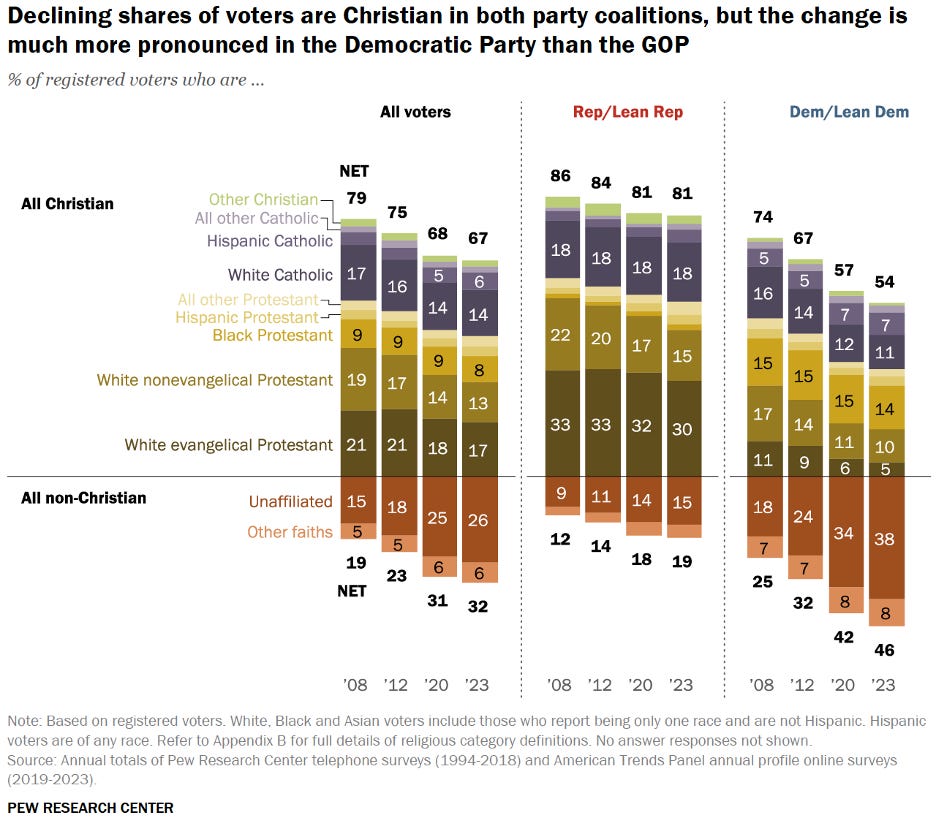
Although the rise of religious “nones” has occurred nationally, the share among Democratic voters more than doubled from 2008 to 2023—from less than one-fifth of Democrats to nearly four in ten—while the percentage of Christians in the Democratic coalition dropped by 20 points. Over this same period there was a slight increase in “nones” within the Republican coalition but only a 5-point decline in Christians. More than eight in ten Republicans identified as Christian in 2023.
Ryan Burge and other social scientists call the wide differential between Democrats and Republicans based on belief, religious attendance, and religious identity “The God Gap”:
When it comes to belief, the trend lines are clear on this point—it’s really in 2010 and beyond when the gaps between Democrats and Republicans explode. The gap between the share of each party that held to an atheist/agnostic belief was pretty small—never more than five points. But within a decade it had nearly tripled. Now, about 21 percent of Democrats don’t believe in God, compared to 8 percent of Republicans.
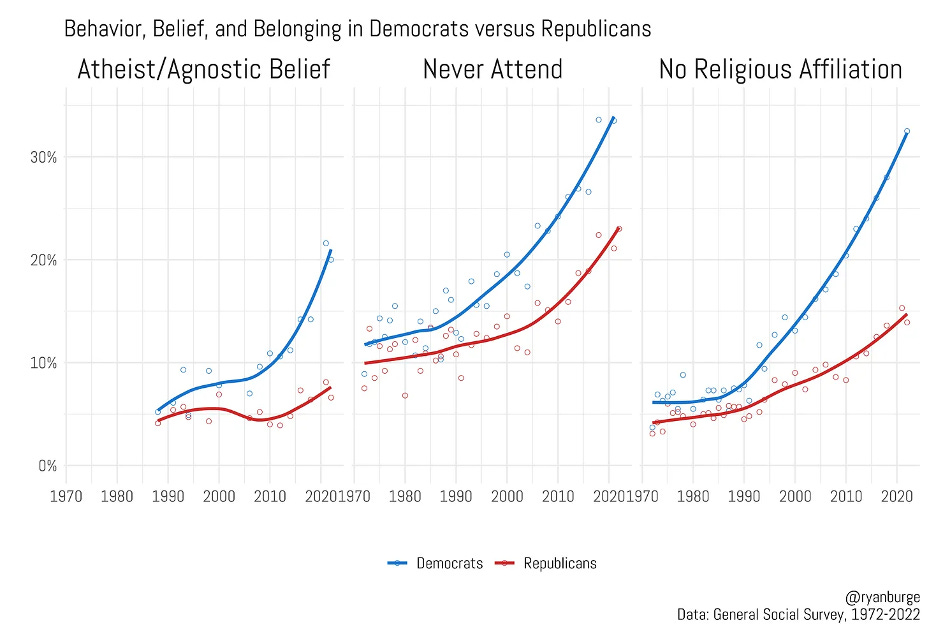
Why does this trend matter in politics? Because the values, beliefs, morals, and attitudes of increasingly secular Democratic elites are at odds with many other Americans who remain religious (mainly Christian) in some capacity or were shaped by religion earlier in life.
On the hot-button issue of gender identity, for example, nearly six in ten religiously unaffiliated voters say that greater social acceptance of people who are transgender (“that is, people who identify as a gender that is different from the sex they were assigned at birth”) is a change for the better versus less than one-third of religiously affiliated voters who feel similarly. On immigration, the pattern is different than you might imagine when listening to some activists quoting the Pope: those with low religiosity are far more accepting of rising immigration than are those with high religiosity. The pattern is the same on the basic issue of the role of government. Those with low levels of religiosity are much more supportive of an active role for government in providing assistance to those in need than are those with high religiosity.
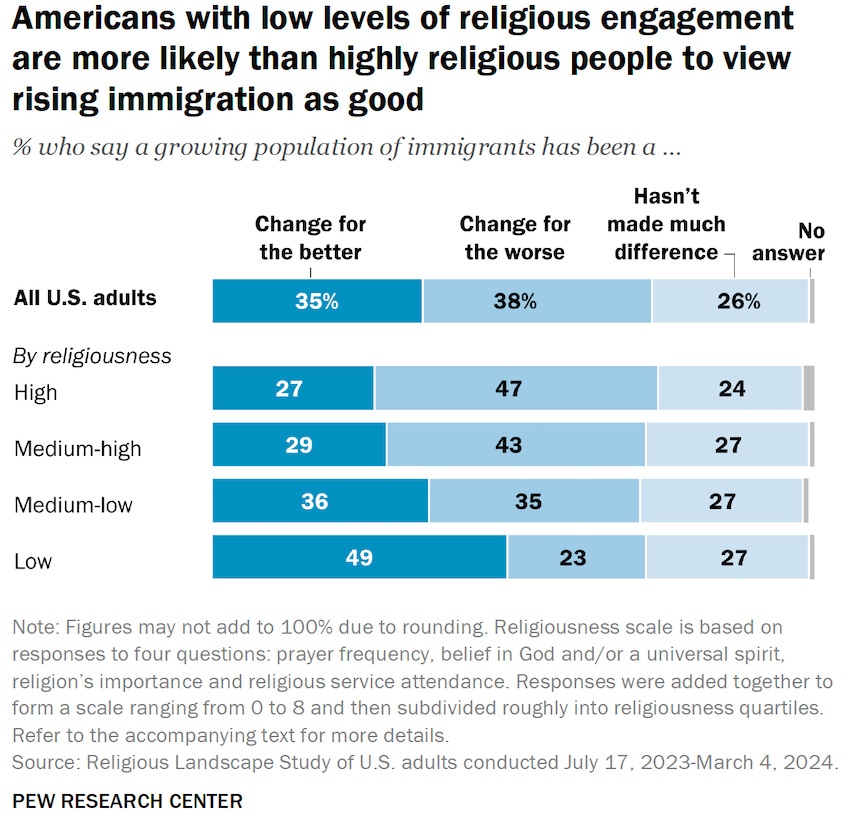
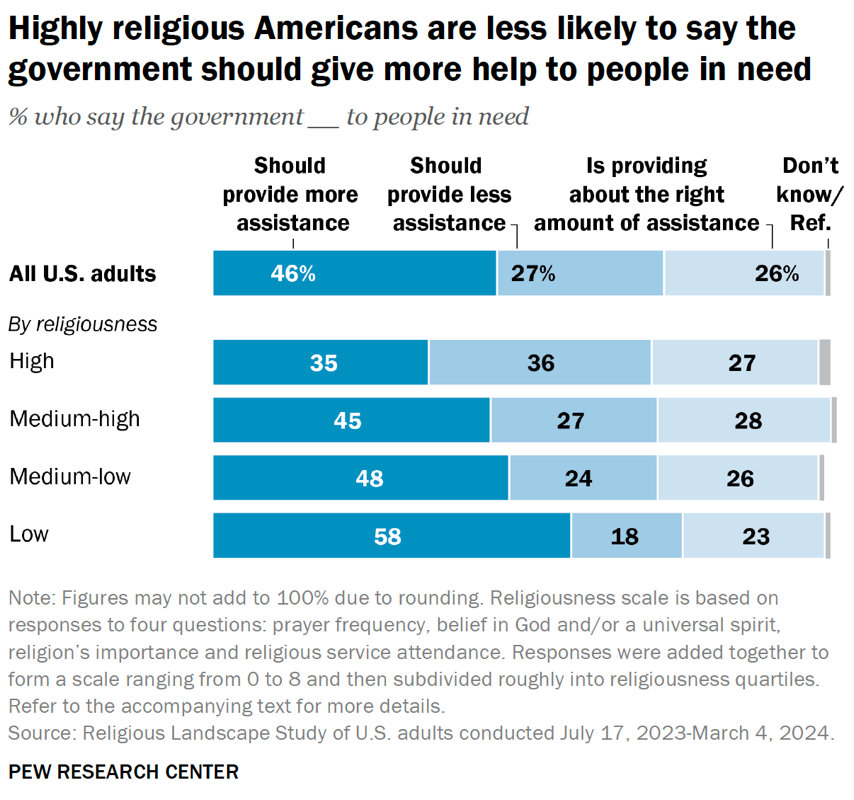
You can see the problem for Democrats. Since more than two-thirds of U.S. voters overall remain Christian, the increasingly non-Christian and secular Democratic Party remains out of touch with a huge chunk of Americans.
No one can make the Democrats be more religious, but Democratic leaders and voters could certainly be more welcoming of the faithful and more accepting of their different cultural and social views. There used to be serious effort put into this religious work prior to the rise of Barack Obama. In the early aughts, the so-called progressive movement spent a decent amount of time and money trying to organize and appeal to both mainline and evangelical Protestants and social justice-oriented and more traditional Catholics, along with both Jewish and Muslim Americans.
But those days are over, replaced by the increasingly zealot-like demands of secular non-profits and democratic socialist ideological movements that decry religious adherents as misguided or worse—“white Christian nationalists.” Democrats not that long ago talked earnestly about faith-based concerns for the poor, the stability of families and communities, and religious tolerance but soon moved on to more strident leftist activism on racial and gender issues, climate change, and anti-Israel agitation. In doing so, they also lost a lot of working-class, rural, and minority voters and gained more geographically concentrated non-religious voters living in big cities. This tradeoff was bad electorally and bad for the country’s pluralistic cohesion.
If Democrats want to rebuild their majoritarian electoral coalition and better represent the values and desires of most Americans, they could start by rediscovering their religious and faith-based roots—or at least stop being so hostile to them.
Editor’s note: The Liberal Patriot will resume publishing on January 5, 2026. Merry Christmas and enjoy the holiday break!
Just remember that the same people who think I’m irrational for being a Christian also believe women have penises. Educated Democrats have a religion that includes sacred texts (Gender Trouble, The Second Sex, The Social Contract, One Dimensional Man) and unfalsifiable metaphysical claims. Their beliefs are all also deeply against human nature, which is why they defund the police, dumb down education, and open the borders. When you reject Christianity you don’t become more rational but less rational.
We went to church last Sunday with our son and family.
The sermon was on feeling joy. Much of the time was spent singing. There was NO ranting about political issues or other peoples' sins. The church was in a small conservative community. For example one neighbor has offered to shovel snow from our family's driveway using his Kubota.....free of charge. When our pregnant daughter-in-law goes to the post office, she never has to carry large packages herself...instead people open doors for her and men carry her packages.
And there was a lot of emphasis in that church on charitable giving. The church was filling baskets of food for those in need. One woman is so poor that she doesn't have a stove, so people in the church are trying to get one for her....including our son.
And before church started, nobody was sitting in the pews. Everybody was up, moving around, talking with each other, laughing. We were new there, and had LOTS of introductions. One of the first things the pastor said when he got everyone (finally) seated was "find someone who you didn't come to church with today in your car and welcome them."
Studies show that conservatives give a higher percent of their incomes to charities than do liberals.
What is there about our church experience last week that does not fit with ideals of the Democratic Party?