



🤖 “A Guide to Which AI to Use in the Agentic Era,” by Ethan Mollick. Mollick, who writes the excellent Substack, One Useful Thing, is out with his latest guide on how to use AI models—both which ones and how—now that we’re moving into the agentic (think autonomous) era of AI. Exciting stuff, and he breaks it down for you in detail.
I have written eight of these guides since ChatGPT came out, but this version represents a very large break with the past, because what it means to “use AI” has changed dramatically. Until a few months ago, for the vast majority of people, “using AI” meant talking to a chatbot in a back-and-forth conversation. But over the past few months, it has become practical to use AI as an agent: you can assign them to a task and they do them, using tools as appropriate. Because of this change, you have to consider three things when deciding what AI to use: Models, Apps, and Harnesses.
Models are the underlying AI brains, and the big three are GPT-5.2/5.3, Claude Opus 4.6, and Gemini 3 Pro (the companies are releasing new models much more rapidly than the past, so version numbers may change in the coming weeks). These are what determine how smart the system is, how well it reasons, how good it is at writing or coding or analyzing a spreadsheet, and how well it can see images or create them. Models are what the benchmarks measure and what the AI companies race to improve. When people say “Claude is better at writing” or “ChatGPT is better at math,” they’re talking about models.
Apps are the products you actually use to talk to a model, and which let models do real work for you. The most common app is the website for each of these models: chatgpt.com, claude.ai, gemini.google.com (or else their equivalent application on your phone). Increasingly, there are other apps made by each of these AI companies as well, including coding tools like OpenAI Codex or Claude Code, and desktop tools like Claude Cowork.
Harnesses are what let the power of AI models do real work, like a horse harness takes the raw power of the horse and lets it pull a cart or plow. A harness is a system that lets the AI use tools, take actions, and complete multi-step tasks on its own. Apps come with a harness. Claude on the website has a harness that lets Claude 4.6 Opus do web searches and write code but also has instructions about how to approach various problems like creating spreadsheets or doing graphic design work. Claude Code has an even more extensive harness: it gives Claude 4.6 Opus a virtual computer, a web browser, a code terminal, and the ability to string these together to actually do stuff like researching, building, and testing your new website from scratch. Manus (recently acquired by Meta) was essentially a standalone harness that could wrap around multiple models. OpenClaw, which made big news recently, is mostly a harness that allows you to use any AI model locally on your computer.
Until recently, you didn’t have to know this. The model was the product, the app was the website, and the harness was minimal. You typed, it responded, you typed again. Now the same model can behave very differently depending on what harness it’s operating in. Claude Opus 4.6 talking to you in a chat window is a very different experience from Claude Opus 4.6 operating inside Claude Code, autonomously writing and testing software for hours at a stretch. GPT-5.2 answering a question is a very different experience from GPT-5.2 Thinking navigating websites and building you a slide deck.
It means that the question “which AI should I use?” has gotten harder to answer, because the answer now depends on what you’re trying to do with it.
🤝 “Survey: Americans aren’t as racially divided as we think,” by the Brookings Institution. Following the last decade of racial turmoil in the U.S., you might expect that race relations in America have grown worse, especially if you get your news predominantly from social media or cable news. But, in fact, new research tells a very different story. The Brookings Institution this week released the results of a national survey that gauged Americans’ attitudes about a host of race-related issues. The findings provided optimism for future race relations in an increasingly diverse country. Among some of Brookings’ key findings:
Americans overwhelmingly reject racial bias in personal and professional relationships. Over 80 percent of adults report that race is not important when selecting friends or business partners—attitudes that are consistent regardless of political affiliation.
Workplaces are centers of interracial interaction: At least 80 percent of adults have at least one co-worker of a different race. And overall, interracial exposure in the workplace shows no broad association with job satisfaction.
In a hypothetical hiring scenario, 85 percent of Americans made race-neutral choices. Across all racial groups and political parties, respondents preferred merit over race in selecting job candidates.
Interracial friendships are common and meaningful. More than half (54 percent) of adults have a close friend from a different race, and 72 percent have at least one casual or close friend from a different race.
Interracial marriages are more common than ever, and 52 percent of adults have dated someone from a different race. In 1980, just 3 percent of married couples were interracial; by 2015, that share had grown to 10 percent. The most significant increases in interracial marriage occurred among white Americans (from 4 percent to 11 percent) and Black Americans (from 5 percent to 18 percent). Asian and Latino or Hispanic Americans continue to lead in interracial marriage rates, at 29 percent and 27 percent, respectively.
The authors do caution that self-reports and hypothetical scenarios may not always reflect observed behavior. But, they add, “These findings reveal Americans aren’t as racially divided as partisan politics and media make it appear.”
🇺🇸 “The American idea turns 250: What does the United States mean today?” essay collection from The Catalyst. The Bush Institute’s latest journal edition focuses on America’s big upcoming 250th birthday with a series of worthwhile essays exploring whether the nation is living up to its founding principles. We particularly liked this essay, “A nation built by farmers,” on the role of agriculture in America’s success, written by Texas rancher Glenn Rogers.
Back in 1776, when the Founders first signed the Declaration of Independence, around 95 percent of U.S. citizens worked directly in agricultural pursuits. As you might expect, such work was cherished: In a letter to John Jay, Thomas Jefferson wrote that “Cultivators of the earth are the most valuable citizens.” Though Jefferson’s “cultivators” were mostly laborers, sharecroppers, or small subsistence farmers, he and America’s other early leaders held them in high esteem. The average farmer fed one to five people, including their own family.
For most farmers, this meant long days struggling to survive, with little time for formal education or creative endeavors.
Early farmwork was done by hand, assisted by beasts of burden. In 1784, George Washington, an early agricultural innovator, was given a prized male donkey by King Charles III of Spain. Washington bred the donkey to female horses to produce mules, which were rare at the time but were valued for their size and stamina. Washington’s efforts, which developed into a successful large-scale breeding operation, earned him the title “Father of the American Mule,” and these animals would dominate U.S. agricultural production for the next hundred years.
Today, most Americans are at least three generations removed from the farm, meaning their grandparents or great-grandparents were the last generation with direct farm experience. Only about 2 percent of the population now works in agriculture, but each U.S. farmer feeds an average of 169 people.
The gargantuan advances in quality of life Americans have enjoyed over the last 250 years would not have been possible without agriculturalists. The fact that 98 percent of our population has been released from the burden required to raise food themselves has meant they have more time to work and innovate in other fields. This freedom has led to mind-boggling creativity. Beginning in the late 18th century, industrialization involving factory systems, interchangeable parts, and assembly lines allowed for mass production. Communication advances produced the telegraph and the telephone. The mid-20th century witnessed revolutionary innovations in electronics and computing, space exploration, defense systems, and medicine, including antibiotics and vaccines. In the last 40 years, we have seen an explosion in connectivity and biotechnology. And today, new developments in artificial intelligence happen almost daily.
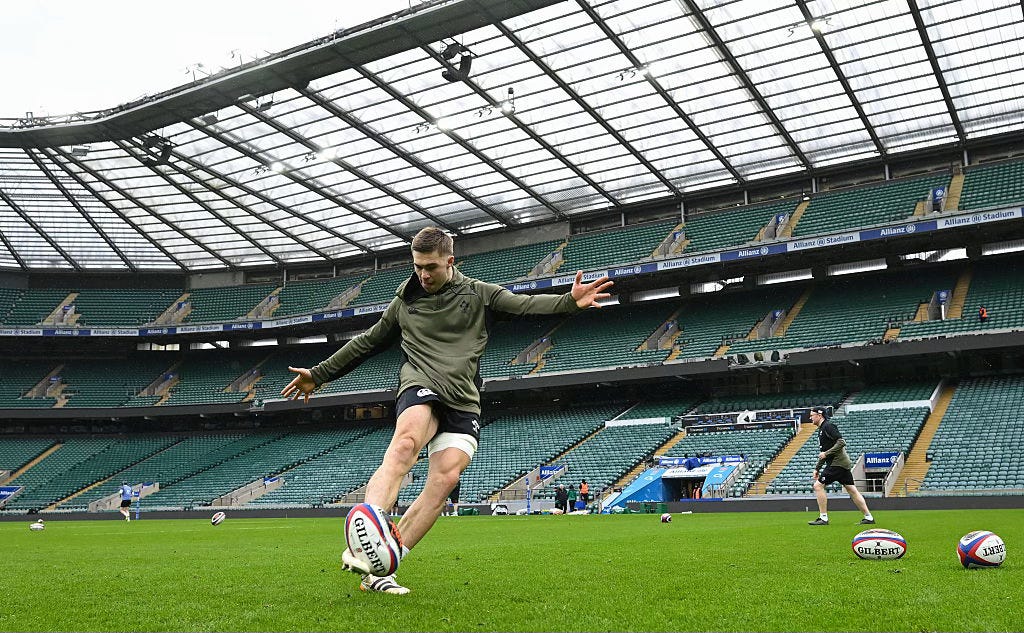
🏉 England v. Ireland, Allianz Stadium, Twickenham. England got walloped by Scotland last week and will certainly be looking to restore some glory against the Irish. Ireland are also looking to defend their pride in this year’s Six Nations with a mixed run so far ahead of this massive matchup at Twickenham.
History hangs heavy over this fixture, with 143 Test matches and the prestigious Millennium Trophy on the line. While England has traditionally dominated on home soil with 48 wins at Twickenham (now Allianz Stadium), modern encounters have been a near-even split, reflecting the fierce competitive parity of the professional era. Tactical intrigue abounds as Alex Mitchell’s aerial bombardment meets the rising talent of Irish fullback Jamie Osborne. In a rivalry where the margins are razor-thin, expect a high-stakes battle of physicality and territory as these two heavyweights collide.
The match starts Saturday at 9:10AM EST on Peacock.
🇯🇵 Heavy Way, by Niningashi. Slink into a soggy winter weekend with this 1970s Japanese masterpiece recently reissued by Time Capsule:
A long-lost Japanese acid folk gem, Niningashi’s 1974 private press debut Heavy Way shimmers with originality, deft song writing and a dream-like groove.
Although he was training as a pharmacist, Kazuhisa Okubo was much more interested in prescribing musical medicine.
A coming-of-age album, Heavy Way captured a turning point in Okubo’s life, and Japanese society more widely as a nostalgia for the pastoral calm of the traditional life, met the cosmopolitan thrill of coffee, sex and cigarettes in the big city.
Intoxicated by Tokyo, driven by a passion for music and surrounded by a thriving acid folk scene, the young student filtered his experiences through a psychedelic cocktail of soulful influences from the U.S. and Japan.
Niningashi was his first band, and Heavy Way was their only album. It was honest and raw, deep and strangely funky, in an off-beat kind of way. Across nine tracks, Okubo and the 6-piece band put their own spin on the new folk sound of Japan, combining witty lyrics with electric guitar-driven solos and crisp, understated grooves.
Dig this opening track from the record, “Ameagari (After the Rain).”
“Following the last decade of racial turmoil in the U.S., you might expect that race relations in America have grown worse,”.
This might be the correct assumption if ‘you’ refers to people on the left. One of the worst insult they can think of is to call someone a ‘racist’. The new Brookings Institute research shows that few Americans are racist, but that term remains a shibboleth of the left.