



🇺🇸 “What Holds America Together?,” by Chris Arnade. Arnade, whose work we have featured before, writes an excellent Substack full of observations from his travels around the world. He is a shrewd, thoughtful observer of humanity and of the United States, specifically. Though his criticisms of America can be unsparing, they are clearly rooted in love of country. In his latest piece, he examines the forces that hold Americans together—and why it’s so important for societies to have some sort of shared culture.
For any country to work, citizens have to believe in a shared “thick” culture. When citizens don’t believe in it, then you will have social and political turmoil. The differences might manifest as disagreements about “thin” issues, because that is the easiest to highlight, but culture repair requires restoring a unified belief in the thick.
For the U.S. that means we need a strong shared belief in the attainability of the American Dream. A person needs to feel they can, with enough hard, decent, and dignified work, buy a home, have a yard, raise a family, and know that their kids will have a better life than they did. Having this unlocks the non-credentialed forms of meaning (family and place) as additional avenues to fulfillment.
I continue to believe that the political turmoil of our last decade is about a disconnect between the front-row and back-row over the availability of the American Dream. As our economy moved to post-industrial (at a pace accelerated by choices of the front-row), emphasizing intellectual work over manufacturing, a large gap opened up between the two in economic well-being, and more importantly, in the ability to make meaning. Non-credentialed forms of meaning became devalued, while careerism became ascendant.
Which is why I’ve been saying the educational divide is our most fundamental divide, because it is about different understandings of what the American Dream is and its availability. It’s a thick culture rupture, not a thin one, and those are always more contentious and harder to repair, because it becomes an epistemological fracture. That is, you get two populations with two different understandings of reality.
☭ Stalin: New Biography of a Dictator, by Oleg V. Khlevniuk. There are many biographies of Stalin, but this one—strongly recommended by Branko Milanovic—is one of the best, if not the best, and endlessly fascinating to read. Why and how did Stalin happen? This book will get you as close as any other to answering some of the most profound questions of 20th-century history.
Josef Stalin exercised supreme power in the Soviet Union from 1929 until his death in 1953. During that quarter-century, by Oleg Khlevniuk’s estimate, he caused the imprisonment and execution of no fewer than a million Soviet citizens per year. Millions more were victims of famine directly resulting from Stalin’s policies. What drove him toward such ruthlessness? This essential biography, by the author most deeply familiar with the vast archives of the Soviet era, offers an unprecedented, fine-grained portrait of Stalin the man and dictator. Without mythologizing Stalin as either benevolent or an evil genius, Khlevniuk resolves numerous controversies about specific events in the dictator’s life while assembling many hundreds of previously unknown letters, memos, reports, and diaries into a comprehensive, compelling narrative of a life that altered the course of world history.
In brief, revealing prologues to each chapter, Khlevniuk takes his reader into Stalin’s favorite dacha, where the innermost circle of Soviet leadership gathered as their vozhd lay dying. Chronological chapters then illuminate major themes: Stalin’s childhood, his involvement in the Revolution and the early Bolshevik government under Lenin, his assumption of undivided power and mandate for industrialization and collectivization, the Terror, World War II, and the postwar period.
🇷🇺 “How four years of war changed Russia. The fighting in Ukraine has reshaped everyday life,” from The Economist. Speaking of Russia, a recent issue of The Economist takes an in-depth look at the internal state of affairs in Putin’s dictatorship after four years of war mobilization against Ukraine. Russia is not in a good place, facing issues ranging from everyday living disruptions and radical shifts in the economy to ongoing fears about the security state and new worries about what to do with all the soldiers if or when the war ends. The Russian system is broken, and its people are deeply unhappy about, if resigned to, their condition.
The war has deformed the legal system in many ways. People who join the army are routinely cleared of past crimes, no matter how depraved. Verstka, an online media outlet, has counted 1,112 court cases, including prosecutions for murder and rape, that have been suspended or dropped because the accused have signed military contracts. As part of the standard benefits package for new recruits, Mr Putin has granted soldiers immunity from prosecution while in service for relatively serious crimes, including theft and battery.
Some soldiers remain violent after returning home. Over the past four years around 1,000 people have been killed or injured by participants in the war, according to Verstka. Half of the murders were committed by ex-convicts recruited to the army from prisons. Although such offenders are usually tried and returned to prison, they often receive lenient sentences.
More than 150 men from Revda, a 60,000-person suburb of the city of Yekaterinburg in the Urals, have died in the war. Last year two sisters, aged nine and seven, were run over and killed outside a supermarket after a car skidded off a slippery road and ploughed into the store. The driver was a 37-year-old corporal, drunk and on drugs, who had recently returned home from the front. He had had his licence revoked three times in the past, but all the associated penalties had been annulled owing to his participation in the war.
Killing has also been sanctified by the Russian Orthodox Church, which has proclaimed the invasion of Ukraine a holy war and sent thousands of priests to the front, both to rally the troops and, in some cases, to fight themselves. At least 300 priests are believed to have signed a contract with the Ministry of Defence, receiving the same privileges as veterans.
From the start of the war Kirill, the church’s patriarch, has promised that sacrificing one’s life in it will wash away all sin, even for the unrepentant. (In contrast, an anti-war protester who displayed a sign reading “Thou shall not kill” was detained and fined for “discrediting the Russian army”.) Alexei Uminsky, a parish priest who left Russia after being defrocked for praying for peace instead of victory, told the media, “The patriarch has removed responsibility for killing in the war.”
In spite of the church’s enthusiasm, enlisting new recruits is getting ever harder. Many are men in their late 30s and 40s from small towns or villages in remote parts of the country with few skills or prospects. “They saw the special military operation as a way to catch up with their more socially advanced compatriots in terms of living standards,” explains Vladimir Zvonovsky, a sociologist from Samara. A signing-up bonus that reached 2.5m roubles in 2024 in some parts of the country (regions competed to please Mr Putin by providing lots of recruits) could be used as a deposit for a mortgage. Wages of 200,000 roubles a month was five times their average salary. It seemed a rational choice, often made together by a family.
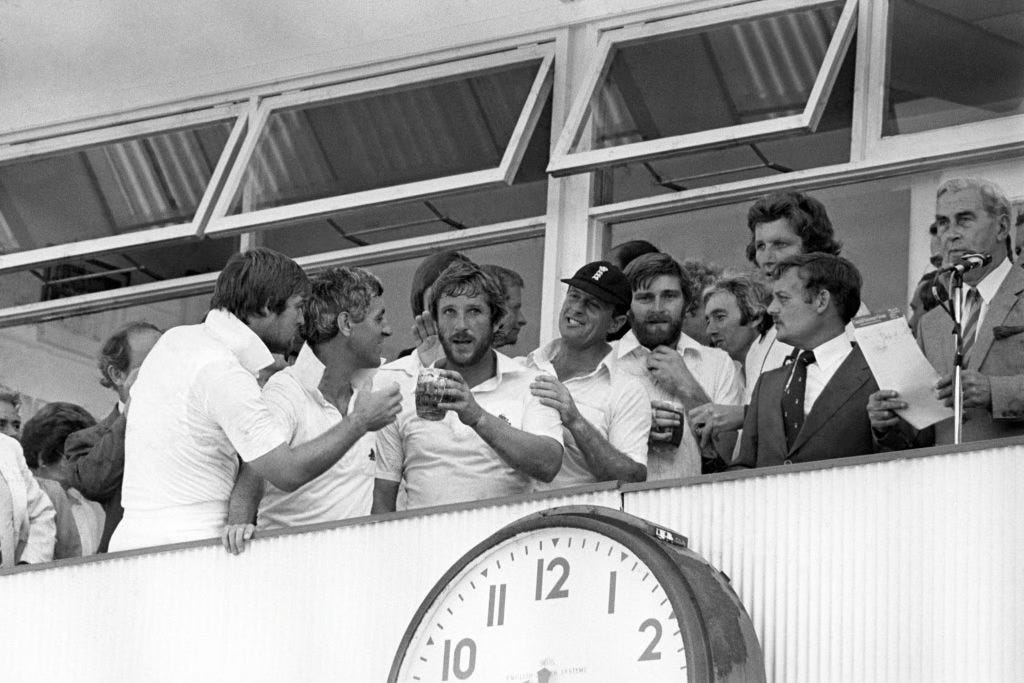
🇬🇧 Who Dares Wins: Britain, 1979-1982, by Dominic Sandbrook. If you like narrative history and the UK, you’ll love this fifth volume in Sandbrook’s series on Britain from the mid-1950s to the early 80s. Sandbrook is a terrific writer, and his latest book is chock full of delightful political and social history and long-forgotten anecdotes about life in the Thatcher era. As he decscribes:
Who Dares Wins is the fifth book in my series about Britain since the war, and covers the shortest period. I spent more time on this one than any of the others, partly because of the sheer wealth of material, but also because I wanted to get it right.
It covers probably the single most controversial period in my lifetime: the first Thatcher administration, which still evokes extremely strong feelings today. Many of the events it covers—the advent of the first woman Prime Minister, the catastrophic recession of the early 1980s, the inner-city riots of 1981, the civil war inside the Labour Party, the New Romantics, the Northern Irish hunger strikes, and of course the Falklands War—could easily take up hundreds of pages. And the cast of characters—everybody from Margaret Thatcher, Tony Benn, and Ken Livingstone to Ian Botham, Simon Le Bon and Clive Sinclair—is almost Dickensian in its lurid variety.
This is also the first book that covers a period I remember reasonably well. But I was only five when the decade began, so my impressions of the early 1980s were dominated by things like the excitement of my first visit to McDonalds, the delights of the BBC Micro, and the mind-boggling drama of the moment Tom Baker regenerated into Peter Davison. All of these things, naturally, are in the book.
Extra listening: Check out Sandbrook’s excellent podcast, The Rest is History, co-hosted with historian Tom Holland.
🎸 Substance, by Joy Division. One of the fascinating bits picked up in Sandbrook’s book is that Joy Division’s mercurial doomster Ian Curtis voted for Thatcher’s Conservatives in the 1979 election. This compilation nicely captures the band’s 1977-1980 output, including the classic single, “Love Will Tear Us Apart,” about Curtis’ troubled marriage and his epilepsy, released one month after his suicide in 1980.
> "For any country to work, citizens have to believe in a shared “thick” culture. When citizens don’t believe in it, then you will have social and political turmoil. "
100%. The Founding Fathers were devout Christians *and* secular deists. But they could both affirm the Declaration of Independence--"that [all men] are endowed by their Creator with certain unalienable rights...". The Founders saw human rights as a supernatural entities that man-made law could never overturn.
By contrast, leftism draws from a more physicalist worldview that rejects supernatural entities like "human rights" or reduces human rights to a man-made legal contract. This goes back to the French philosopher Jean-Jacques Rousseau. He redefined freedom as submission to the "general will," and then said that those who refused to submit should be "forced to be free." Rousseau gave intellectuals the power to decide what was good, and the authority to impose it on the population whether they liked it not. Leftism is violent and authoritarian in its philosophy, and history has proven that out from the Reign of Terror through the gulags through censorship in Europe.
Moreover, in rejecting the moral principles on which the West was built, it means that leftists must hold that the West itself is evil and corrupt. This means leftists hate the first civilization to abolish slavery, the first civilization to have universal literacy, including for women, and the first civilization in the modern era to have democratic government. So there is no common ground between authoritarians who believe the West is evil and Enlightenment-inspired liberals who believe the West is good.
So we can all become leftists and hope that the Soviet Union 2.0 works out better, or we can reject leftism and continue to create things that are good. There is no common ground here.
Spent some time going down a Notes rabbit hole and after watching a parade of leftists defending the worst regimes in the world, here is my question:
Is there one dictator that you don't support? One theocracy that you don't defend? One socialist nation that you'd like to see free? One totalitarian regime that you'd grudgingly give kudos to Trump for overturning?