



The Democrats are set for a good—perhaps very good—2026 election. They seem almost certain to take back the House and the Senate, while still improbable, is within reach. But once they stop congratulating themselves for taking advantage of thermostatic reaction against a floundering Trump presidency, they’ll face a fresh and more daunting challenge: who to nominate for their 2028 presidential candidate?
That nominee is crucial for two reasons. Most obviously, Democrats should want a candidate who will maximize their chances of taking back the presidency. Successfully sorting through the potential nominees to find that candidate is not a given. On a deeper level, parties typically rebrand themselves after a period of coalitional attrition through a presidential nominee who newly defines their image (think Clinton, Obama). The 2028 nominee should ideally provide that new template for the national party.
That’s the assignment. The Democratic presidential primary electorate will be the ones carrying it out (or not). At this point, what can we say about those voters and what they might be inclined to do? Clearly it’s early and any poll that attempts to survey that electorate cannot precisely predict what it will look like in 2028. That said, Third Way has just released a treasure trove of data (topline, memo, presentation, crosstabs) on these voters that illuminates the playing field aspiring Democratic candidates will have to negotiate. Here are some of the most interesting findings.
(1) The Democratic presidential primary electorate is dominated by women (61 percent), whites (65 percent), and non-college voters (60 percent). In addition, a clear majority (55 percent) are over the age of 55; just 12 percent are under 30.
(2) In terms of ideology, the Democratic primary electorate skews liberal to left as one would expect. The survey asks about ideology in two different ways:
socialist/progressive/liberal/moderate/conservative
very liberal/somewhat liberal/moderate/somewhat conservative/very conservative.
In the first categorization, socialist (6 percent) + progressive (11 percent) + liberal (43 percent) are 60 percent of the sample; in the second categorization very liberal and somewhat liberal are both around 31 percent making liberals 62 percent of primary voters when categorized in that way. Moderates in both categorizations are 34 percent of the sample while conservatives are a trace presence.
Naturally, liberals are to the left of moderates on most questions on the survey but this difference is attenuated if you use the first categorization, which subtracts out the socialists and progressives, who are very left, from the liberal category. Moderates are also relatively close to those who are somewhat liberal in the second categorization while those who say they are very liberal (which includes nearly all the socialists and progressives) are quite far to the left of both. Of course, one should remember that, in turn, moderates who vote in Democratic presidential primaries are quite far to the left of moderates in the overall electorate.
(3) Some common-sense ideas that candidates could include in their platforms generate almost unanimous support for candidates who back them. These include: “Building on the Affordable Care Act to cap health care costs for everyone, making it easier to choose your own doctor, stopping hospital price gouging, and streamlining medical bills” (96 percent overall support); “Providing more low-cost vocational training and apprenticeship opportunities, so people can get good-paying jobs in growing fields without a four-year college degree” (95 percent); “Investing in a range of energy sources, including clean energy, to meet our rising energy demand and bring down our bills” (95 percent)”; and “Overhaul ICE to focus only on dangerous criminals, not families who have lived in the U.S. for years and are contributing to their communities” (93 percent). Such proposals not only have overwhelming support within the Democratic primary electorate, they should also be salable to independents, swing voters, and some disaffected Republicans.
(4) On the other hand, some classically left-identified proposals that would be hard to sell outside the ranks of partisans also have strong support within the Democratic primary electorate. These include: “Creating an annual nationwide wealth tax on billionaires” (91 percent overall support); “Passing Medicare for All, meaning that the government provides everyone’s insurance and private insurance is eliminated” (83 percent); “Passing a national plan like the Green New Deal that would move rapidly to eliminate fossil fuels” (74 percent); “Cancelling all student debt and making college free” (72 percent); and “Abolish ICE and halt all immigration enforcement inside the country” (59 percent).
Here though there is meaningful variation across ideological categories within the primary electorate. For example, on Medicare for All, those who are very liberal provide 88 percent support while moderates are significantly lower at 75 percent. On free college and no student debt, the very liberal are at 83 percent, socialists are at 95 percent and progressives are at 90 percent compared to moderates who are down at 63 percent. A Green New Deal and eliminating fossil fuels is supported by 84 percent of those who are very liberal but just 62 percent of moderates. Finally, abolishing ICE and ending interior immigration enforcement has 79 percent support among the very liberal, 80 percent among socialists, 79 percent among progressives but is actually net negative among moderates (47 percent support vs. 53 percent opposition).
Still, there is no gainsaying the fact that, despite the near-unanimous support for moderate reform proposals, there is very significant support for more left proposals—proposals which cold well prove more exciting to voters in the context of heated primary contests. The possibility is real that the Democratic primary electorate could wind up supporting a candidate who not only wouldn’t be the probability-maximizing choice against the GOP opposition but also would do nothing to fix the Democrats’ brand problem—indeed would just make it worse.
(5) Underscoring this potential problem, Democratic primary voters express support for the party becoming more liberal to beat Republicans and say that only a “true progressive” could excite them as a candidate. In the survey, 55 percent say the party should become more liberal. However, while support for this proposition is overwhelming among the very liberal, socialists and progressives, it drops to 42 percent among moderates.
And 62 percent call for a “true progressive” to excite them. Similar to the pattern above though, 97 percent of socialists, 88 percent of progressives and 83 percent of the very liberal demand a true progressive while moderates are split down the middle on the question.
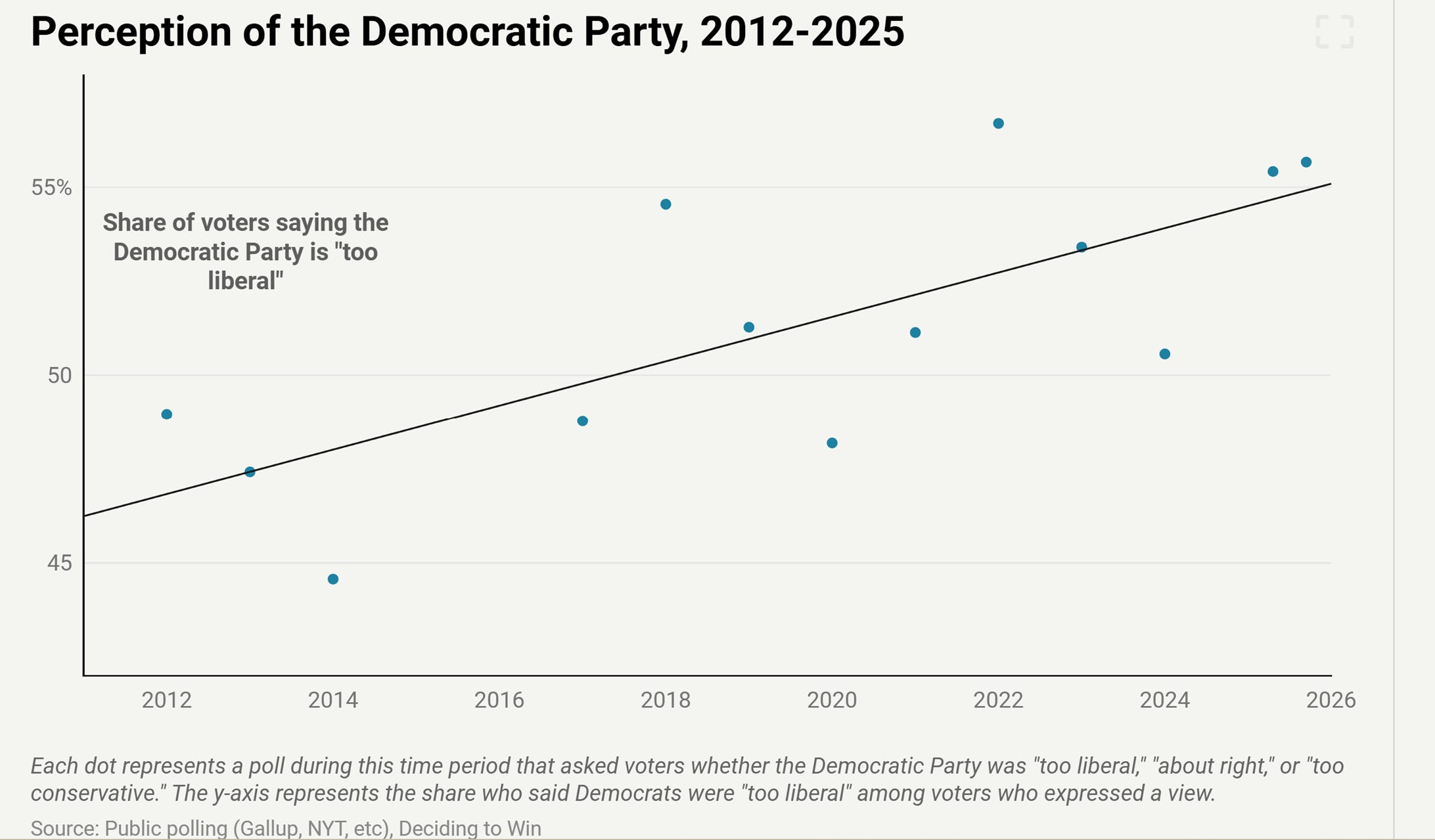
This is more than a bit disconcerting given that the overall electorate has increasingly seen the Democrats as too liberal over time. Quite a few Democratic primary voters are apparently willing to press the accelerator on this.
(6) But when put in the context of electability, Democratic primary voters show more flexibility and pragmatism. Over three-fifths (62 percent) declare they would vote “for someone who can win the general election against a Republican” rather than “for someone who stands by their progressive values, even if it could make them less electable.” This includes 57 percent among those who say they are very liberal. Only the socialists dissent strongly from this preference.
Conversely, 55 percent disagree that nominating a moderate Democrat would just be repeating the mistakes of the past because it wouldn’t excite people to vote. However, here the progressives and very liberal join the socialists in dissenting from the overall judgement.
The problem with this welcome pragmatism—at least among the majority of Democratic primary voters—is that it hinges on a good understanding of who, in fact, is electable. Right now, Kamala Harris and Gavin Newsom—two liberal California Democrats—sit atop Democratic presidential nomination polling, garnering nearly half of overall support. They are, respectively, the fourth worst and flat-out worst in performance relative to underlying partisan lean of 21 potential candidates tested by the “Deciding to Win” report. Moreover, another top contender is AOC who is also an underperformer relative to her district.
Of course, there’s plenty of time for overperformers like Josh Shapiro and Andy Beshear to make a case for their electability and potentially an audience for that case. But it will take some work and hard politicking. Nothing can be taken for granted given how seductive the siren song of the left may be in the upcoming presidential cycle as the Third Way data make clear.
It’s all to play for. Gentlemen and women, place your bets.
I don't think it's progressive to allow biological men to compete in women's sports. I see it as misogynistic.
Excellent research, but Talarico's Nov success in Texas, or lack thereof, is going to determine much for Dems in 2028. If Dems can sell a Democratic Socialist as a moderate, in Texas, and win, Dems will continue to move ever more Left. Why wouldn't they, if they can win with different packaging, rather than different policies?
Dems successfully sold Spanberger as a moderate last November. It took a day for Spanberger to declare VA a Sanctuary State. Dozens of new tax proposals followed.
It took another month or two for an undocumented man to brutally murder a VA Mother at a bus stop. The murderer, with 30 previous charges and various convictions, some violent, was never deported, despite repeated crimes spanning more than a decade.
At that point, even Reps expected a Spangerber speech, promising to hunt down any other predators dwelling illegally and preying on VA women. Many expected the new Governor to promise the harshest punishment allowed by law, followed by swift deportation.
Instead Spanberger felt compelled to announce a judicial warrant would be required to release the predator to ICE. In other words, if a technicality released the monster from jail, the VA Gov would refuse to hand over the violent repeat offender to ICE, as normally transferred. Without the extra step of a judicial warrant, the predator would walk out of jail, free of incarceration and deportation, to kill yet again.
Spanberger's declaration amounted to a new Dem Immigration White Paper. As long as Dems are running the show, all are welcome and all can stay forever, including those who stab to death 40 year old American Mothers, for kicks. The most disturbing aspect is, if Talarico wins in Texas in Nov, we haven't seen anything yet.