



You know that sensation when you bump into someone while you’re out walking the dogs or getting a coffee and instantly regretting engaging in any conversation that goes beyond, “Lots of snow this year, huh?” or “The Ravens really blew it but feeling good about the O’s.” If you do make the mistake of moving beyond cursory small talk, you’ll invariably discover that the person you thought was somewhat sane has completely bonkers views about “Zionism” or “fascism” or “the liberal media” or the “Epstein class”—insert whatever issue or conspiracy you can imagine from any ideological perspective.
“Okay, pal, I have to run; great to say hi to your pup!”
It’s not clear when it happened—maybe starting around 2015 or earlier with the rise of smart phones, Twitter, and high-speed internet access everywhere—but politics is now the absolute worst conversation topic in modern America. People are mostly fine if you stick to life and other diversions when talking. But the minute the topic turns to politics, people across the partisan spectrum become totally insufferable. It’s all mindless tribal signaling. There’s no nuance. People don’t listen. And they certainly don’t aim to learn something new through a political discussion with another person. Often these days, your political interlocutor will regurgitate questionable “content” absorbed from social media or some agit-prop podcast or influencer. They hate Trump; they love Trump. They think Democrats are sell-outs; they think Republicans are authoritarians. Israel committed “genocide”; Palestinians are all terrorists. Progressives are a bunch of wokesters; conservatives are a bunch of white nationalists. The media is biased to the left; the media is reactionary. On and on.
“Please, God, make it stop.”
If you feel this way when talking about politics either in person or online, you’re not alone. The Pew Research Center and the Knight Foundation just released a new study in their ongoing series examining Americans’ views about news, politics, and the media. Strikingly, as seen in the chart below, the researchers found that in 2025 nearly six in ten U.S. adults admitted that they had stopped talking with someone else about political or election news because of something that person said. In 2019, less than half of adults felt this way about political and election-related discussions.
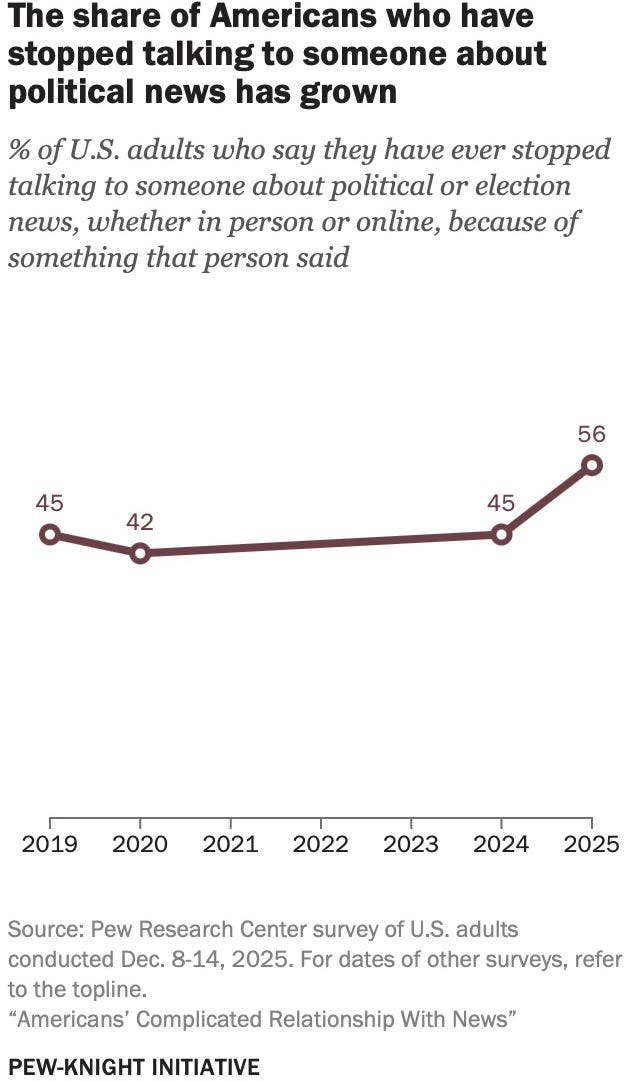
This finding and others like it are typically interpreted as highlighting the increasing intolerance of different opinions among certain types of people—e.g., those with very firm beliefs about politics and elected officials, the college educated, or older people set in their ways. Intolerance is not the entire story here but it certainly plays some part in why people don’t want to talk about politics. In the Pew-Knight research, for instance, more than three quarters of self-identified liberal Democrats reported having stopped talking to someone because of something they said about politics compared to just over half of self-identified conservative Republicans. Likewise, about two-thirds of college graduates said they have stopped talking to someone because of politics versus 46 percent of those with a high school education or less. And more than six in ten people ages 65 or older said that they have cut someone off over politics compared to just over half of those under age 30.
In separate qualitative work, researchers asked people to explain why they might stop talking to someone because of something they said, finding that it is part discomfort and part wanting only to talk among the safety of the tribe:
Some focus group participants discussed tempering what news they discuss based on who they’re talking to. “I can talk about the economy with just about anybody if they’re willing to listen to the boring stuff,” a Democratic man in his 40s said. “But if we go into politics and stuff like that—I’ve lost a lot of friends.”
A Republican woman in her 40s said, “I tend to only really talk about political things when I know I’m with people that are like-minded, just because there’s—it’s just easier that way.”
Another way to interpret the results above is to think of not talking about politics or current events with others as a form of self-preservation. When Pew-Knight asked respondents if various feelings had kept them from discussing the news with others, around six in ten U.S. adults overall agreed that “concern about making things uncomfortable,” a “lack of knowledge about the news,” or a “lack of interest in talking about the news” contributed to their reluctance to talk about current events, respectively.
The generational divide about discussing politics and the news is striking. Only 35 percent of those ages 18-29 in the Pew-Knight study say that it is “extremely” or “very important” for people to get news on a regular basis compared to 65 percent of those ages 65 or older. Less than one third of the youngest adults believe that to be a good member of society, it is “extremely” or “very important” to follow the news versus six in ten of the oldest Americans. Likewise, 55 percent of the youngest adults report that they are “worn out” by the news compared to only 42 percent of the oldest ones. Forty-four percent of those in the younger cohort say they don’t have enough time to follow the news compared to less than one-fifth of the oldest cohort. Fifty-two percent of 18–29-year-olds also say that most of the news they come across is not relevant to their lives, while only four in ten older Americans agreed.
It’s interesting to consider reading this study and other research that older, more academically credentialed, and partisan people are the main sources of social tension when it comes to talking about politics. These types tend to be more unmovable and opinionated than others, regardless of their ideological perspective, and therefore end up being the most annoying and unpleasant people to encounter in the wild. In contrast, young people often get pegged for being the most zero-sum and intolerant age group when it comes to political topics—probably because of campus-based fights over identity, social issues, and foreign policy—when, in reality, most young people are just trying to keep up with life and not get into politics for any number of sound reasons.
This leads us to an important piece in the Wall Street Journal this past weekend, “These Schools Want Civil Discourse on Campus. Even That Is Up for Dispute,” written by Pamela Paul. (Ruy is interviewing Paul for this week’s TLP Podcast; be sure to listen in on Friday.) Paul looks at recent efforts on some college campuses such as the University of North Carolina at Chapel Hill and the University of Iowa to create better conditions for the discussion of contentious intellectual and political topics. These new programs and institutes within universities vary in structure and focus but all recognize that having civil discussions requires ground rules like those laid out to students at UNC: “Nothing they said would leave the room. Nobody would be shouted down. No one would get ratted out on social media as ‘problematic.’”
Of course, many of these new programs have been labeled as “right-coded” given their origins and focus and politics writ large. Yet the ideas behind these programs actually seem more liberal than conservative in the old sense of the word—as in someone who is liberal-minded, tolerant, open to new ideas, and willing to consider competing arguments and different lines of thought. As one of the students who participated in a School of Civic Life and Leadership class at UNC told a professor:
I’m grateful for the way it pushed me this semester. It forced me to slow down, read more carefully, and take arguments seriously even when they weren’t coming from a place I was comfortable with. That shift has already changed how I think about my work going forward.
This commitment to creating a more civil approach to discussing differences could be beneficial to everyone in America, not just young people, who may be frustrated by talking about politics or resigned to keeping their views quiet to protect themselves. It seems like a lot of work to interact with others in this way, but it might help to improve the overall mood and tenor of American life, even a small bit.
It’s either trying this more open-minded and considerate method of political discourse or putting on sunglasses and headphones and moving right by others when you’re out on your next dog walk. Maybe a little of both would work. Just my opinion.
I think that Progressives are much more comfortable wearing their politics on their sleeve. As someone in Deep Blue America, I think Progressives have fun loudly mocking something Trump did or said in a non-political situation, while conservatives keep their mouths shut.
Progressives generally imagine everyone already agrees with them, so they see no issue.
The Ancient Greeks considered politics to be the 5th branch of philosophy. Politics are the means by which we implement our philosophy in the real world.
The US was built on a philosophy. For most of our history, Americans agreed with and embraced the ideas of the Declaration and the Constitution. They understood that the US wasn’t perfect, but we were working toward our philosophical ideals. Our politics were about means, not ends.
That’s no longer true. Now we have a fairly large group of people who believe our history is evil. That our Constitution is a “living document” which they are eager to stretch to any interpretation so they can justify imposing their version of utopia on the country.
Divisive politics is only a symptom. A clash of philosophy is the source of the problem.