



Last week, the U.S. Census Bureau released new population estimates. While the big takeaway from the data was that country’s population growth has slowed since last year—largely a result of the Trump administration’s immigration crackdown—it also reinforced another trend we saw in the first part of the decade: several blue states are experiencing a major slowdown in growth while key red states are leading the pack. And if these projections materialize in the 2030 census, they could have a profound effect on American politics in the next decade and beyond.
According to three different analyses of this data, here is the list of states that are likely to gain or lose U.S. House seats (and, correspondingly, electoral votes or EVs) as well as their net seat gain:
Blue states: California (-4), Illinois (-1), Minnesota (-1), New York (-2), Oregon (-1), Rhode Island (-1)
Swing states: Arizona (+1), Georgia (+1), North Carolina (+1), Pennsylvania (-1), Wisconsin (-1)
Red states: Florida (+3), Idaho (+1), Texas (+4), Utah (+1)
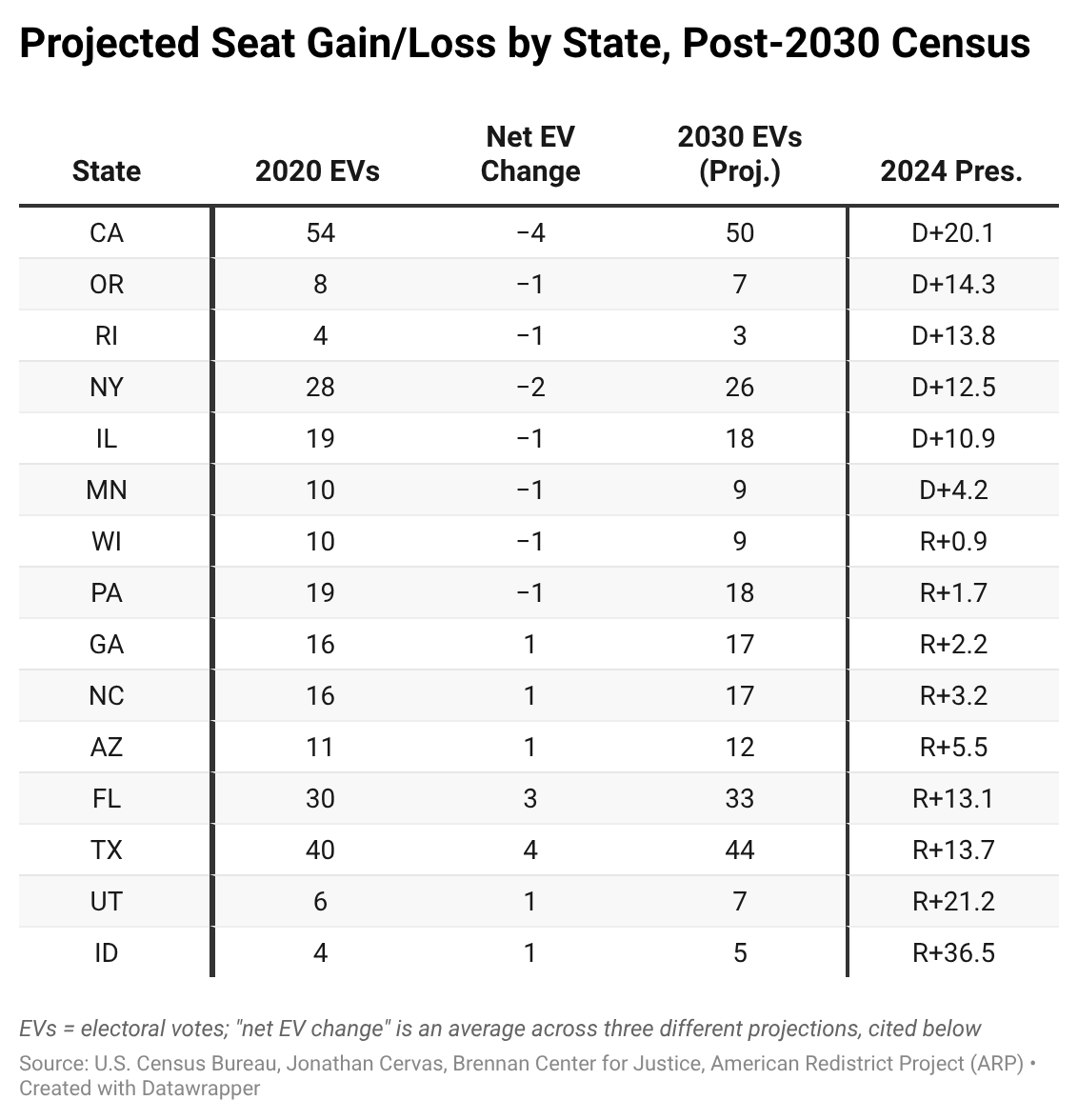
This picture is striking: Democratic states are projected to lose ten EVs while Republican states are expected to gain nine. The biggest blows to Democrats are the four-seat loss in California and two-seat loss in New York. But just as concerning for them are the seven seats that Republicans are projected to gain in Florida and Texas alone.1 These changes would dramatically shift the equation for both parties when it comes to winning the Electoral College, giving Republicans a stronger advantage and closing off crucial paths to 270 EVs—the number needed to win the presidency—that existed for Democrats in each of the last three elections (and likely will in 2028 as well).
Throughout the Trump era, as the Electoral College has grown ever-more competitive, analysts and strategists have spent substantial time debating the most efficient ways for each party to win it. Both parties are typically expected to bank the states that lean heavily their way. After that, they must find a route through the remaining swing states to reach 270.
Such was the case in 2024. Kamala Harris’s “bankable”2 states amounted to more EVs (226) than Trump’s (219), giving her more possible paths to 270. Most observers zeroed in on two in particular. The first was the Sun Belt—specifically, North Carolina, Arizona, Georgia, and Nevada. This region was younger, more diverse, and had experienced significant growth. Though these states had moved left in recent years, Democrats had not been competitive in most of them for very long. The other went through three Rust Belt states: Michigan, Pennsylvania, and Wisconsin. This region was older, less racially diverse, and growing less quickly. These states had a long history of voting reliably Democratic—so much so that they have been dubbed the party’s “Blue Wall.” But they had also become more competitive for Republicans in recent years, with Trump winning all three in 2016.
The most optimal scenario for Harris was to sweep both regions. However, she could have won the presidency by carrying only one or the other: the Blue Wall alone would have gotten her to 270 exactly, while the Sun Belt alone would have gotten her to 275. Meanwhile, Trump was starting with a lower floor and therefore needed a larger slate of states to win. Carrying only the Sun Belt would have left him just shy of winning with 268 EVs, while adding only the Rust Belt states kept him at 263. (Of course, he ultimately swept both.)
But this balance now appears set to change. If the 2030 census data largely reflects this year’s estimates, neither the Blue Wall route nor the Sun Belt route would, by themselves, be enough to lift future Democratic nominees to the presidency. For starters, Democrats would no longer hold an advantage over Republicans in their respective tallies of “bankable” EVs. Whereas Democrats currently enjoy a seven-EV edge (226 to Republicans’ 219), this would flip. They would lose nine bankable EVs while Republicans would gain the same number, leaving the latter with an 11-point margin among these states (228 to Democrats’ 217).
Then, accounting for a one-seat loss in both Wisconsin and Pennsylvania, the Blue Wall alone would now only get Democrats to 259 EVs. They would need to add at least one of Arizona, Georgia, or North Carolina to get to 270. (Nevada, which has a longer history of breaking for Democrats in presidential elections than the other three, only adds six EVs, leaving the party still short at 265.)
The Sun Belt offers more promise, as three of the four states there are projected to gain one seat each, leaving the region with ten more EVs (52) than the Blue Wall (42). However, even if the Democratic nominee swept the Sun Belt, it would only put them at 269—resulting in an Electoral College tie. They would thus still need to pick up at least one Blue Wall state to win.
Another way of thinking about all this: if we apply these changes retroactively to the 2024 map, Harris would have lost ten additional EVs, going from 226 to 216, while Trump would have gained ten, jumping from 312 to 322. The New York Times produced a handy graphic3 showing a whopping 66 different paths to 270 that would have worked for Harris in 2024 but that would no longer produce a win for Democrats if the census projections hold:
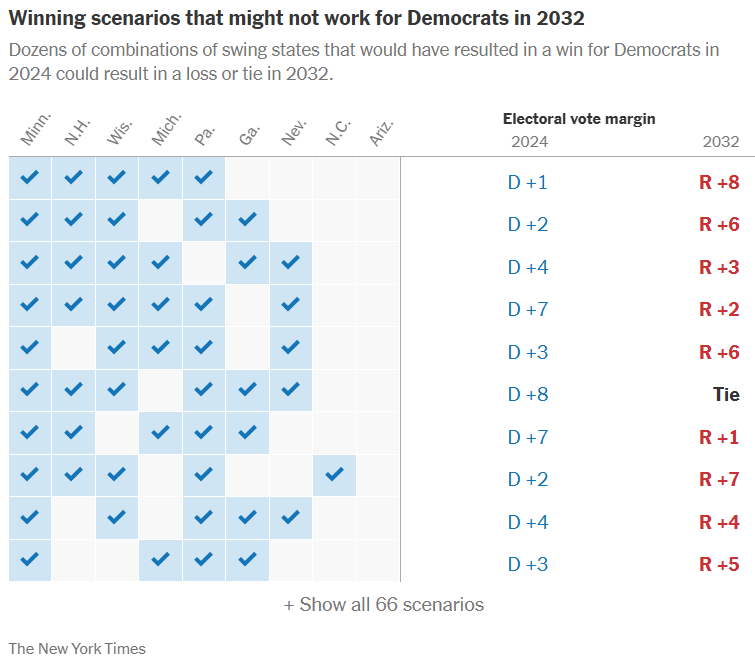
Of course, in recent history, both parties have been competitive in the Electoral College, and it’s not inconceivable that future Democratic candidates could sweep all of the swing states and secure a healthy 311 EVs. But this brings us to another complication for Team Blue: since 2016, each of the seven states comprising these two regions has voted to the right of the nation at least once. Four of them—Pennsylvania, North Carolina, Arizona, and Georgia—did so in all three elections.
In other words, Democrats’ path to 270 EVs will require them to win big in territory that has been less friendly for them than for Republicans in recent elections. As DDHQ analyst Geoffrey Skelley notes, the new map would shift the tipping-point state—or the state that delivers the 270th EV—even further to the right. In 2024, that was Pennsylvania, which leaned 1.7 points more Republican than the nation. Now, it is set to be Georgia, which voted 2.1 points to the right.
However, it’s not all doom and gloom for Democrats just yet. First, things change quickly in politics. And while the Electoral College right now is tilted against the them, there is no guarantee this will persist indefinitely. One reason is that political parties have survival instincts. If the Democratic Party in its current form begins struggling to win presidential elections, it will be forced to evolve. It’s also possible that, say, some Hispanic voters in the Sun Belt who swung against the party in 2024 could come back to them in the face of Trump’s aggressive deportation program, making them more consistently competitive in that region. If this puts states like Florida and Texas back on the map for them, suddenly everything changes.
Second, these early projections may simply not pan out. We saw this after 2020. One forecast, for example, showed Alabama and Minnesota losing one seat each while Arizona gained one seat—none of which ultimately happened. It also overestimated the number of seats that Texas and Florida would gain. Much of this also hinges on the administration of the actual census count, an imperfect process that sometimes overcounts or undercounts different states’ populations. Additionally, as GOP pollster Patrick Ruffini has pointed out:
Blue states and cities campaign to get people counted, and with more people packed into dense urban environments, [they] have more ways to get people counted without talking to them directly. Conservatives, meanwhile, have often raised suspicion about the entire enterprise.
Ruffini also noted that it’s unclear what the impact of Trump’s crackdown on illegal immigration could be. His administration is trying to change how the Census Bureau collects data—namely, to base apportionment only on each state’s citizen population rather than the population as a whole, as it is currently done. It’s likely that this move will face legal challenges before 2030. But more importantly, among the states with the largest unauthorized populations (and that are notably cooperating with the administration on immigration enforcement) are the two that stand to see the biggest EV gains based on current projections: Florida and Texas.
It remains to be seen how everything shakes out. But this year’s projections are not all that different from last year’s, and population trends are increasingly telling a clear story: blue states are suffering from out-migration, and red states are reaping the rewards. Moreover, many of the people leaving deep-blue states like California are not only Republicans, but they are often moving to the very states Democrats don’t want to see shifting further right, such as Arizona, Florida, Nevada, and Texas.
The upshot is this: starting in 2032, the road to the presidency is likely going to run through Republican turf until further notice. And Democrats will need a plan—quickly—for what to do about it.
According to DDHQ’s Geoffrey Skelley, each of these changes would be among the largest post-census shifts since at least 1970.
“Bankable” states are those that the Cook Political Report listed as either “likely” or “solid” Democratic or Republican in their final 2024 pre-election ratings.
The Times’ chart also included Minnesota and New Hampshire, which both went Democratic in 2024 but by less than five points each.
Ok so this might sound a little nutty, but please bear with me here. Maybe, just maybe Democrats should take a moment to consider that the main reason their brand is in the toilet is due to them turning states they fully control into places people move from. Conversely Republicans have been turning states they control into places people move to. So it’s possible that the Democrats’ current policies do not actually work and should be moderated if not scrapped completely.
I know it sounds crazy but if they can pull off a well governed blue state that people actually want to move to, more people might actually vote for them. At a minimum it would certainly make it harder for Trump to come off as the lesser evil.
interesting take on this. "The Electoral College" is poised to get tougher on Democrats.
yeah that dammmnable Electoral College. Like all democratic institutions that hobble the Democratic Party, it's GOT TO GO !! by hook or by crook.
.
We must all sing the same song - America loves us and wants our policies they just don't know it and the ELECTORAL COLLEGE is the problem.
.
wait.
what if ...
the problem was people moving OUT of blue states and INTO red states?
what if
the problem is that Blue polices don't work so good for economy, crime, schools . .
whaaaa -- that's it who said that? KICK HIM OUT! we don't want no freethinking around here.
.