



🎭 “The Trouble with Quitting the ‘Trump-Kennedy Center’,” by Kat Rosenfield. President Trump’s insistence on reshaping American culture in his image has predictably engendered backlash. Following his takeover of the John F. Kennedy Center for the Performing Arts in DC—which went from ousting the organization’s bipartisan board and installing his own people to adding his name to the building in a move that is probably illegal—scores of artists have withdrawn from their planned performances in protest, most recently the renowned classical composer Philip Glass. Writing in the Free Press, Kat Rosenfield argues that most artists seem to think they have two options: “cancel your Kennedy Center appearance as an act of resistance, or take the stage and be labeled a collaborator.” But “this Manichaean worldview misses the existence of a third option, one that allows artists to step outside the binary, and outside politics.” She continues:
As a novelist myself...I’m not unsympathetic to the notion that the only sensible response to Trump’s clumsy attempts to anoint himself the Greatest Patron of the Arts in the Known Universe is to take one’s ball (or jazz vibraphone) and go home. Certainly, I don’t want to live in a world where all the art is predicated on simping for the president, any more than I wanted to live in the circa 2020 culture of all privilege-disclaiming resistance porn, all the time.
And yet, I’m also not persuaded that artists are best serving their craft, their calling, or their country by simply ceding the national symbolic seat of American culture to Trump—or by announcing, through their absence, that making a rote display of disdain for one politician is more important than whatever broader message they might have conveyed to audiences through their work.
For one thing, [boycotting the venue isn’t a meaningful act of resistance]. But even if Trump were genuinely wounded by this...this is still not worth the cost of encouraging artists to absent themselves, to renege on promised performances, to cheapen their own work by treating it like a bargaining chip. To even indulge in the notion that there’s such a thing as Democrat or Republican art is to forget that art is meant for greater things—and that while it may reflect or respond to politics, it also invariably transcends them, in a way that makes it all the more important during moments of turmoil, fear, or disagreement…
Because art speaks to all of us, including to the worst of us—and while this doesn’t make a person’s bad acts any less evil, or his politics any less despicable, it does remind anyone who might have needed reminding that he is a person. Flawed, weak, human. Loved by some, hated by others, and destined like all the rest of us to return to dust.
To recognize this is not to make excuses; it is not capitulation or betrayal…If anything, history tells us that these are the moments it becomes most necessary to set aside space for making music, or telling stories—to value art for the transcendence it offers and the truth it reveals. If we care about the arts, if we care about our art, the integrity of the Kennedy Center is surely something to be fought for.
🇭🇰 Golden Boy: Memories of a Hong Kong Childhood, by Martin Booth. Hong Kong in the 1950s was another world, now lost forever. But Martin Booth’s fascinating, beautifully written memoir allows us to visit what is now gone and get at least a sense of what it was like. From the New York Times review of the book:
In the Hong Kong of the early 1950s, Martin Booth was a walking good-luck charm. His golden-blond hair, a symbol of good fortune, was his passport as he roamed the streets. Passing strangers would reach out to pat him on the head. Shopkeepers indulged him. Once, a leper reached out in desperation, and, Booth writes, “fleetingly, so that I could hardly feel it, he touched my hair.”
Booth really was lucky. In 1952 his father, a glorified clerk in the Royal Navy, received a chance posting to Hong Kong. Overnight, Martin was transported from the cold, gray Britain of postwar rationing to a neon-lighted fantasy land that seemed expressly designed to keep a 7-year-old boy entertained around the clock. Within days of his arrival, he watched a servant kill a cobra by picking it up and cracking it like a whip, observed necromancers and phrenologists at work in front of a local temple and watched in fascination as a street vendor carefully trimmed the eyebrows of his clients and then, with a silver spatula, removed the wax from their ears.
For three years, Martin—Mah Tin to the shopkeepers, coolies and hotel employees he befriended—moved in a dream world, enchantingly recreated in “Golden Boy.” Bold and curious, he treated Hong Kong as his personal amusement park, making a beeline to every single location expressly forbidden by his parents.
“Golden Boy” is a grand adventure, seen through a boy’s eyes but remembered by a novelist with a sensualist’s appreciation of sights, sounds and tastes. Martin, a fearless rover in the tradition of Huck Finn or Jim Hawkins of “Treasure Island,” covers every inch of his new territory, approaching strangers without fear and sampling strange foods without flinching. One of his first triumphs occurs at a street stall in Kowloon, where he points to a preserved black egg, served with pickled sweet vegetables and a dipping sauce.
“A crowd gathered,” he writes. “The spectacle of a blond European boy sitting at a dai pai dong alone of an evening was more than most could resist.” Martin eats, and the crowd applauds. The owner refuses payment. The blond boy has brought good luck, filling every stool in the stall.
🇮🇷 The Persian, by David McCloskey. Iran has been in the news quite a bit recently, so there’s nothing better on an icy weekend than kicking back with some intriguing spy fiction set in Tehran, written by former CIA analyst David McCloskey:
Kamran Esfahani, a dentist living out a dreary existence in Stockholm, agrees to spy for the Mossad after he’s recruited by Arik Glitzman, the chief of a clandestine unit tasked with running targeted assassinations and sabotage inside Iran. At Glitzman’s direction, Kam returns to his native Tehran and opens a dental practice there, using it as a cover for the Israeli intelligence agency. Kam proves to be a skillful asset, quietly earning money helping Glitzman smuggle weapons, run surveillance, and conduct kidnappings. But when Kam tries to recruit an Iranian widow seeking to avenge the death of her husband at the hands of the Mossad, the operation goes terribly wrong, landing him in prison under the watchful eye of a sadistic officer whom he knows only as the “General.”
And now, after enduring three years of torture in captivity, Kamran Esfahani sits in an interrogation room across from the General, preparing to write his final confession.
Kam knows it is too late to save himself. But he has managed to keep one secret—only one—and he just might be able to save that. In this haunting thriller, careening between Tehran and Tel Aviv, Istanbul and Stockholm, David McCloskey delivers an intricate story of vengeance, deceit, and the power of love and forgiveness in a world of lies.
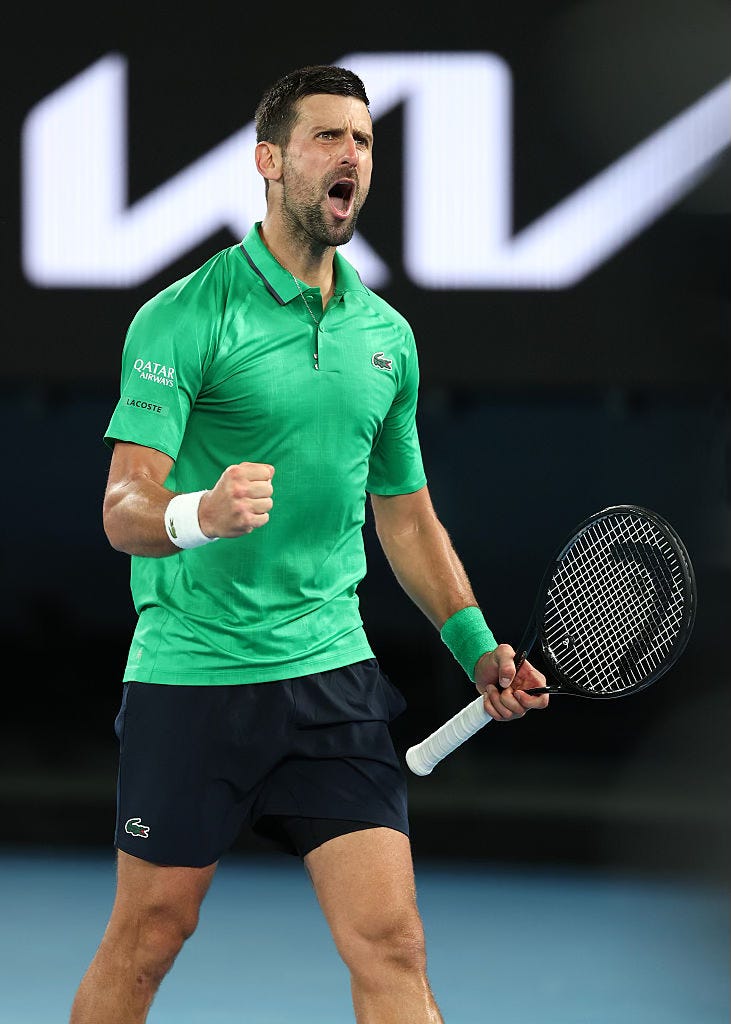
🎾 Australian Open Men’s Final, from Rod Laver Arena, Melbourne Park. Novak Djokovic is 38 years old and holds the all-time men’s tennis record of 24 Grand Slam titles, the most Grand Slam match wins ever, the most Grand Slam finals, and a stunning ten Australian Open titles. He should probably be retired and telling some of his signature jokes at this point. But no, “Nole” put on one heck of a show against the superb youngster, Jannik Sinner, to make the finals of the Aussie Open once again:
Novak Djokovic was in monster mode on Rod Laver Arena, spot-serving Jannik Sinner off the court, pinning the two-time champion in the light blue behind the baseline and going through his full repertoire of exertion-induced showmanship. The 10-time Australian Open champion even found time to vomit at least twice into a towel, just as Alcaraz had done earlier in his semifinal.
The crowd roared for Djokovic as only Melbourne Park does, through every curling ace and blasted forehand. In between them, especially after the first two sets, Djokovic celebrated, roared, keeled, stumbled, stretched, and limbered his way around Rod Laver Arena. He slammed forehand after backhand after forehand into the corners, roping Sinner from side to side, drawing errors from everywhere. Sinner, 14 years his junior, was flummoxed. Sinner, who had beaten him five times in a row, was unable to stem the tide. Djokovic won in five sets, 3-6, 6-3, 4-6, 6-4, 6-4 to move one major away from another record in the greatest career the men’s game has ever seen.
Sunday’s final features No. 4 seed Djokovic against No. 1 seed, Carlos Alcaraz, starting in the wee hours of the morning EST time on ESPN.
🎶 soft shakes, by Go Kurosawa. The Kikagaku Moyo drummer/vocalist and self-described '“son of a music teacher and a flower seller,” Go Kurosawa, is out with a silky solo record that finds him playing all the instruments across eight lovely tracks (electric guitar, acoustic guitar, electric bass, drums, piano, organ, keyboards, trumpet, clarinet, marimba, shaker, tambourine, bongo, melodica, chimes, whistle, woodblock, cowbell, Buddha Machine, and vocals.)
Groove out to some “Moon, Please” this weekend while your heating bill hits absurd new heights.
Love your weekly music links.
It all looks interesting, but "Golden Boy: Memories of a Hong Kong Childhood" piqued my interest enough to order a copy. Thanks!