



It’s no secret that the center of gravity in the Democratic Party has shifted left over the past decade or two. Whereas the base of the party not long ago was older, working-class, moderate black voters, it increasingly comprises college-educated white liberals. This, along with greater levels of partisan polarization and geographic sorting, has over time helped erode the party’s moderate faction in Congress and given rise to new progressive power bases in big urban cities like New York, Chicago, and Seattle.
And while these transformations have made the party more capable of dominating in off-year elections, it has also become harder for Democrats to compete in some parts of the country and with certain voting blocs that were a core part of their coalition not long ago—and that made them capable of winning big at the federal level. Post-election analysis after 2024 found that more Americans today believe Democrats are too liberal than when Barack Obama sought re-election in 2012.
Yet, even in the midst of this transition, a significant share of Democratic voters actually remain ideologically moderate, possess complex views and attitudes on the issues, and aren’t necessarily cheering the party’s leftward shift. Shortly after the 2024 election, for example, a Gallup survey found that a large plurality (45 percent) wanted to see the party become more moderate against only 29 percent that wanted it to become more liberal.
Last week, two prominent think tanks released surveys showing moderate Democrats remain a major part of the party’s coalition. The first came from the center-left Third Way, which found that roughly 40 percent of Democratic primary voters self-identity either as moderate (34 percent) or conservative (five percent).1 Moreover, Democrats overall appeared to hold pragmatic views of politics. For instance:
89 percent agreed that “just because a candidate is moderate does not mean they are boring.”
88 percent said they are “willing to vote for someone I don’t agree with on every issue as long as they are strong and will fight for the working people of this country.”
75 percent said they prefer “a candidate who works across the aisle to get things done, even if it means compromising sometimes” rather than one who “sticks to their progressive beliefs, even if it means getting less done.”
72 percent are “willing to vote for someone I don’t agree with on every issue as long as they are authentic and true to what they believe in.”
And fully two-thirds believe “nominating a Democrat for president who is too far left risks losing the general election to a MAGA candidate, because America is not liberal and someone far to the left will turn off swing voters.”
Most Democrats hold pretty normie views on key issues as well. Two-thirds support overhauling ICE and holding it accountable rather than abolishing it entirely (34 percent). A large majority (62 percent) also continues to support capitalism over socialism (38 percent). According to the report’s authors, these findings demonstrate that “primary voters are pragmatic, and they don’t want their nominee to go so far left in a primary that they can’t win against MAGA in the general.”
The second survey came from a more unexpected source: the Manhattan Institute (MI), a conservative think tank.2 MI set out to determine whether “the median Democratic voter [is] actually moving left—or…the party [is] being pulled left by a smaller activist faction that dominates elite discourse and low-turnout politics.” They found that the party’s coalition is “often more moderate, more internally divided, and more pragmatic than what is found across left-leaning social media, cable news, and donor-funded groups,” and that “more voters favor moving the party toward the ideological center than further left.”3
In fact, compared to Third Way, MI’s data found that moderates make up an even greater share of the party’s coalition at 47 percent. Meanwhile, “Progressive Liberals” (PLs) are 37 percent while the “Woke Fringe” (WF) is just 11 percent.4 MI dug deeper into Democratic voters’ views on hot-button issues and found that they are much more complex than people may realize.
Immigration. Democrats of all stripes continue to see America as a nation of immigrants, but pluralities of moderates (50 percent) and PLs (44 percent) believed that the number of legal immigrants allowed to enter the U.S. each year should “stay about the same” rather than be increased from current levels (16 percent and 27 percent, respectively).
Trans issues. Democratic voters often take more cautious positions here than people may expect—even as the party doesn’t always do the same. A plurality of voters overall (including a majority of moderates and plurality of PLs) believe that sporting events should be separated on the basis of sex rather than “gender identity.” Huge majorities across all demographic and ideological cohorts except for the WF (which was split) also believe that medicine for gender transitions should not be administered to people until they are at least 18 years old.
Crime. Only 18 percent of Democrats believe that the U.S. criminal justice system is “too tough” in its handling of crime. A plurality (34 percent) think it’s “about right,” while a similar share (31 percent) say it is “not tough enough. A large majority (55 percent) also agrees that “police are essential—they should remain the primary way communities address crime and public safety,” while just one-third believe that “police do more harm than good, [and] funding should be shifted toward non-police alternatives.”
Israel. Nearly half (49 percent) of Democrats say that while they believe Israel has a right to exist, they are worried about how Israel has conducted its war against Hamas. By contrast, only 13 percent agree that “Israel is a colonial apartheid state”—a position that some leading 2028 contenders have espoused—and that it, alone, bears responsibility for “any and all violence that has followed its establishment.”
Billionaires. The overwhelming majority of Democrats (73 percent) believe that billionaires can exist, even though they want to see them contribute more in taxes. By contrast, just 14 percent say billionaires are “bad for society and shouldn’t exist,” a belief most pronounced among the WF.
These two surveys illustrate that the Democratic electorate is a mixed group and, like most Americans, holds a diverse set of views, especially among its most moderate members. The MI results are especially interesting: a right-leaning organization might have an incentive to show that Democratic voters are uniformly left-wing, which could provide ammunition for the GOP in its pursuit of swing voters and independents. And yet, this is not the story their data told.
Still, these surveys also showed concerning signs for center-left reformers about moderates’ influence—or, perhaps, lack of it—in the party today. For starters, both found that a majority of the Democratic coalition is not ideologically moderate. In the Third Way study, fully 60 percent self-identified as either liberal, progressive, or socialist. And anyone who did the math above will know the MI study found that a plurality (48 percent) either belonged to the PL or WF camps.5
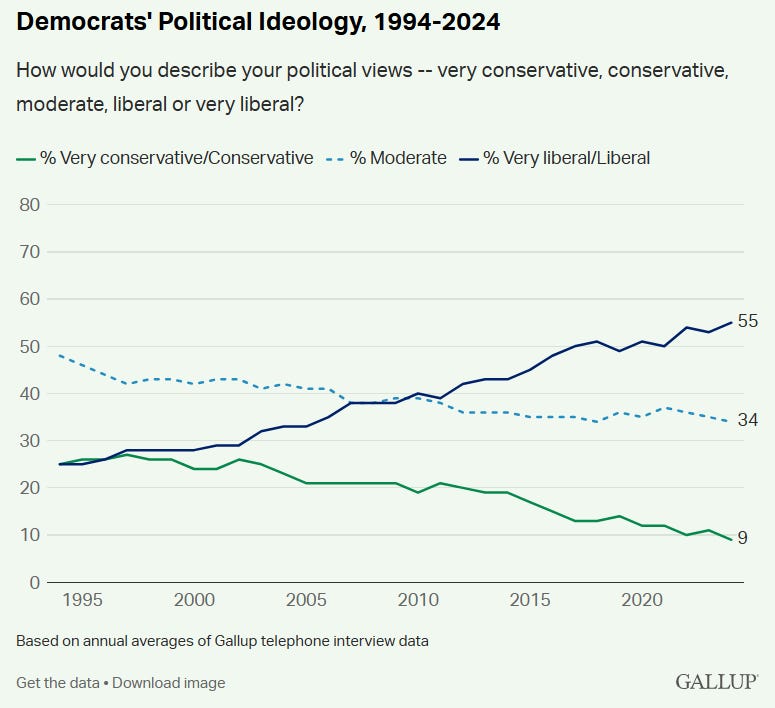
This data mirrors other surveys from nonpartisan groups that have shown the share of moderates and conservatives in the Democratic Party on an inexorable, decades-long decline while the share of liberals is at its highest point on record, as is the share who identify as “very liberal.”
Third Way’s data also showed that even as large shares of Democrats purport to want more moderation from the party, many would still support candidates who espouse support for things like “Medicare for all” (83 percent), the “Green New Deal” (74 percent), and canceling student debt and making college free (72 percent)—all policies that have gotten the party’s candidates into trouble in the past. Two-thirds of voters also say that a candidate needs to be a “true progressive” for them to get excited about voting.
This presents another problem. Many Democrats purportedly want an “electable” candidate—recall that 66 percent said “nominating a Democrat for president who is too far left risks losing the general election to a MAGA candidate.” But MI’s polling shows that several of the top 2028 contenders they support are either way to the left of the median American or serial electoral underperformers.
So, even as most Democrats tell themselves that they want their party to moderate to win over the voters they need, there is clearly a leftward gravitational pull internally. The energy and vibes in a primary election today are likelier to be with candidates like Zohran Mamdani and AOC—whose brand of politics animates the party’s base but will very likely struggle to win over swing voters in key states in a general election—than with moderate reformers like Rahm Emanuel or center-left candidates with strong electoral track records like Josh Shapiro.
Here’s how MI put it:
Activist politics often speaks for the most ideologically intense voters, but on many issues, the majority view within the coalition is that of the Moderates—often alongside black and Hispanic voters—rather than the party’s most activist faction. The Woke Fringe, however, may still exert outsized influence in low-turnout primaries and online discourse. Because this group is younger, it represents a plausible source of future ideological change inside the party, even if it is not the median position today.
This doesn’t mean that moderates are out of luck or that the party is fated to an AOC nomination in 2028. But the winds right now are at the back of the progressive base. If moderates want to chart a different way forward for the Democrats, they’ll need to identify and rally behind a consensus candidate who offers to chart a different path—and they’ll need to do it sooner than later.
Third Way surveyed 1,400 likely Democratic presidential primary voters.
Manhattan Institute surveyed three separate national audiences: 1,782 registered Democrats and/or 2024 Harris voters, 828 black Democrats and/or 2024 Harris voters, and 388 Hispanic Democratic and/or 2024 Harris voters.
Some Democrats may be reluctant to listen to anything a right-leaning outfit has to say, but it is probably wise to hear them out. As one center-left Democrat from the Bipartisan Policy Center put it, “Sometimes your opponents have a more honest view of you than you can muster.”
I’m sure some liberal readers will recoil at the term “Woke Fringe.” These monikers and descriptions were formulated by MI and derived from the results of the survey. For reference, the Woke Fringe comprises voters who describe themselves as a “Democratic Socialist” or “Communist.”
The large gap between the two surveys is likely the result of methodological differences in how each one defined their cohorts.
As a conservative, MAGA Republican, I found the questions posed to the Democrats polled in this article devoid of substance. Instead of asking, "Do you like billionaires", why not ask if the rich should pay more taxes"? All Dems would say "Yes". Another question not asked "Has Donald Trump accomplished anything positive for the country in his second term"? Probably 100% of Dems would say "No". How about "Are there any members of Trump's cabinet qualified for their positions"? Like, seriously? What about Trump's foreign policy of "peace thru strength"? Is it good for America's security? That would garner another "Solid No". Are you in favor of "sanctuary cities and states"? Of course!. Should all illegals be deported even if they haven't committed any crimes? Good gosh, "No". Is forcing voters to show "I.D." to vote important? "Certainly not - blacks don't have proper identification because of slavery". Should we "save the planet" or "drill baby, drill"? My experience with Dems of all blends is that they don't think critically, are afraid to take tough stances on crime and immigration, think their policies are working even if it causes pain to the country ("The Green Revolution") , and would rather see the country fail than Trump succeed. It's sad and disappointing.
First, I would love to know where these “moderate” Democrats exist in the real world. As a largely closeted conservative in a PMC career in a blue state, I’m privy to private political conversations and I’ve never heard anyone try to push back against far-left narratives.
Second, I wish these “moderates” were asked what percentage of Federal Income tax revenue they think the top 1% pays. (It’s about 40% to 45%)