



At the end of last year, we wrote about how the 2026 midterm environment was shaping up to be a good one for the Democratic Party. They have been cleaning up in special and other off-year elections. Their lead in the generic ballot is ticking steadily upward. Consumer sentiment is abysmally low. And Donald Trump’s approval rating—including on the issues that won him the 2024 election—is cratering.
Despite this apparent momentum, however, one place that could still be a challenge for Democrats this November is the U.S. Senate. The upper chamber of Congress has long had a bias toward states with relatively large rural populations, and as American politics has grown more polarized along urban-rural lines, especially during the Trump years, Republicans have gained a clear edge in the fight to control the Senate.
Since the 1994 midterms, the GOP has controlled the Senate for a total of 20 years while the Democrats have had the majority for only 12. And since the start of the Trump era (2016), Republicans have held the majority for eight years, averaging a six-seat margin, compared to Democrats’ four years and average one-seat margin.
At present, Republicans have a 53–47 margin in the Senate. Because they also hold the presidency, they could stand to lose up to three seats and still hang on. So the question is: can Democrats net four seats this November and win a majority?
Let’s first look at the big picture. Historically, the president’s party loses congressional seats in midterm elections. The losses are almost always steeper in the House than in the Senate, given how many more seats the former has. They are also usually greater for the president’s party when his approval rating is underwater. Going back to the 1960s, parties that controlled the White House lost an average of just one Senate seat when the president’s approval sat above 50 percent. However, that figure grew to 3.6 seats when his approval was below that benchmark.1
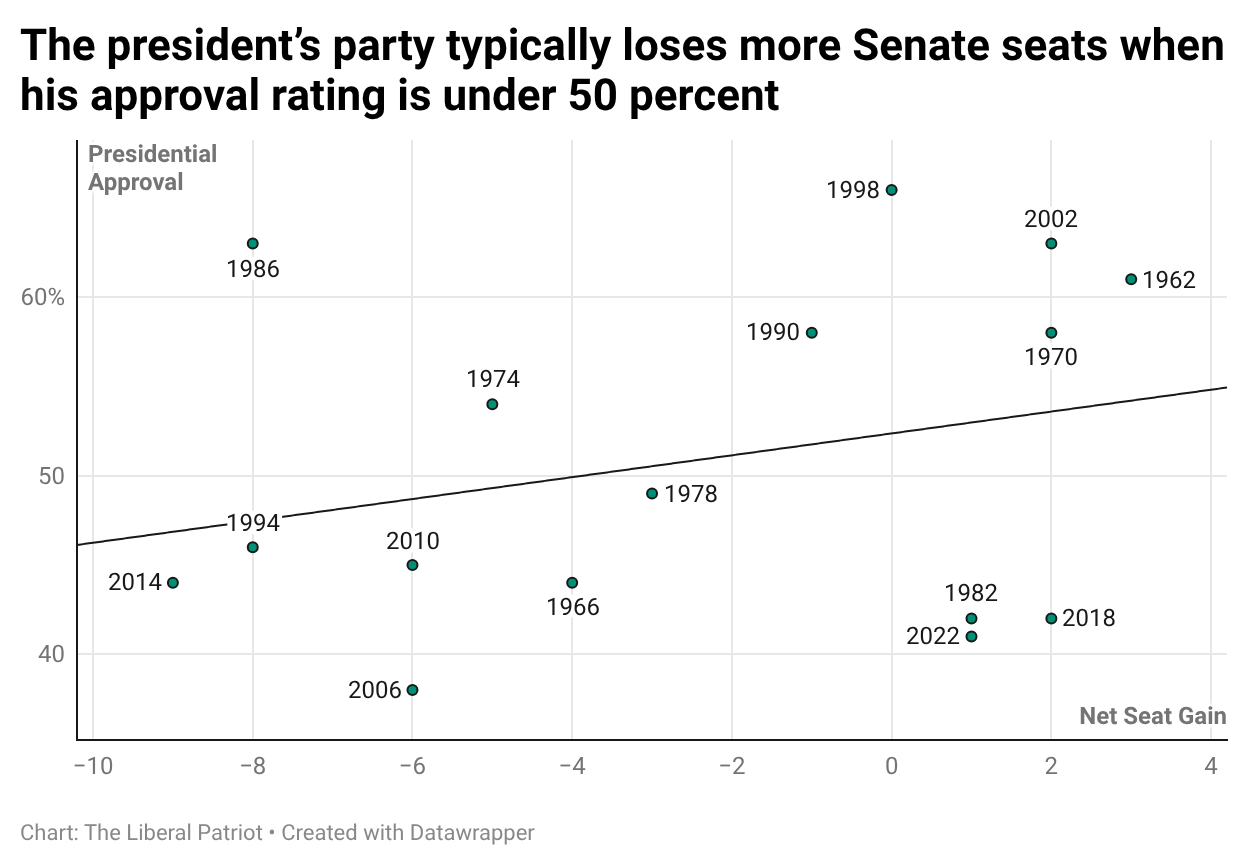
The good news for Democrats is that Trump’s approval rating is under 50 percent—it sits at just 41 percent as of this week, per Nate Silver’s averages. Moreover, it has been ticking steadily downward since last summer, and it is unlikely to be back up to 50 or higher by this November.
However, there is also reason for caution. For starters, even if we round the average 3.6-seat loss in the chart up to four seats—the number Democrats need for a majority—it’s still an estimate from the past, not a guarantee of what will happen this year. The bottom-right corner of the chart offers another complication. In each of the last two midterm elections, the incumbent president’s approval rating sat in the low 40s, and yet their party saw a net gain in Senate seats: two for Republicans in 2018 under Trump and one for Democrats in 2022 under Biden. This is a good reminder that it also matters which specific seats are up for election.
Consider 2018, Trump’s first midterm. Democrats that year picked up two Senate seats as part of a blue wave election nationally. But Republicans also flipped four Senate seats of their own, all in states that Trump had won two years earlier. Three of the four—Indiana, Missouri, and North Dakota—had backed him by at least 18 points, and we now know that the fourth (Florida) was starting to trend more Republican at the time.2
The landscape this year is slightly different, and Democrats won’t be defending any seats in states that broke heavily for Trump. But the path to 51 seats won’t be easy, either, even if his approval rating stays in the basement.
To be sure, Democrats are still favored to make net gains this year. For starters, most observers expect that they will successfully defend on their own turf. Though there are two Democratic incumbents running in states Trump won—Georgia and Michigan—his 2024 margins in them were much narrower (2.2 points and 1.4 points, respectively) than they were in most of the states Republicans flipped in 2018. And this time, the national environment should be much friendlier for Democrats.
Moving to Republican territory, the strongest Democratic pick-up opportunity is likely Maine, which Kamala Harris won by 6.9 points. Incumbent Republican Senator Susan Collins has been a strong candidate for years, though it’s very possible her luck will run out this year as partisanship continues to harden. Then there is North Carolina, where incumbent Republican Senator Thom Tillis is retiring, leaving an open seat. In a good year, this would be a strong Democratic target as well. Assuming they defend all of their other seats, adding these two states would put them at 49 in total.
This, however, is where things get very tricky. Remember, Democrats would need to net at least two more seats to win the Senate, as a 50–50 split still gives the GOP a majority with Vice President Vance serving as the tie-breaking vote. At this juncture, there appear to be four other Republican-controlled seats that could be viable targets for Democrats.
Alaska. This may be Democrats’ best bet for getting to 50. They notched a big recruiting win when former Congresswoman Mary Peltola agreed to run for the seat against Republican Senator Dan Sullivan. Peltola won both an August 2022 special election for an open Republican seat and the subsequent general election but lost re-election in 2024. She proved to be a fundraising juggernaut in each of those campaigns, and she should have the political winds at her back this year. Meanwhile, Sullivan is among the least popular incumbent senators today, and early polls show Peltola with a slight lead. The big question is what the electorate will look like. Alaskans voted for Trump in 2024 by a healthy 13 points, though Peltola kept her race much closer, winning 48.8 percent of the vote at the end of ranked-choice voting. This race is probably a must-win if Democrats are to have any shot of securing a majority.
Iowa. Though Democrats were competitive in the Hawkeye State for decades, it swung hard to the right in 2016 and has remained there ever since. As of today, they hold just one statewide office: state auditor. And in 2024, Trump carried the state by 13 points, the largest margin there of his three presidential runs. This will undoubtedly be a harder lift for Democrats. However, the current incumbent, Joni Ernst, is not seeking re-election, leaving behind an open seat. Congresswoman Ashley Hinson is the presumptive Republican nominee, while Democrats look to have a three-way primary that includes state Senator Zach Wahls and state Representative Josh Turek. The other factor that may be working in Democrats’ favor is the fundraising picture. Though Hinson faces little real competition for the GOP nomination, end-of-year filings show that she does not have a substantial money lead over the Democratic candidates. Still, Democrats have not won at the federal level in Iowa since 2008, and it’s unlikely that will change this year.
Ohio. If Democrats can flip Alaska’s seat, Ohio might be their best bet for getting to 51. Of the four states on this list, Ohio went for Trump by the smallest margin in 2024 (though he still carried it by 11 points). The biggest reason for Democratic optimism here is their recruit: former U.S. Senator Sherrod Brown, who served from 2006 until 2024, when he lost his seat by 3.6 points. Part of Brown’s appeal in this blue-collar state has been his persistent focus on helping improve life and conditions for American workers. In a better national environment this year, Brown could be poised for a comeback. He won’t have the benefit of incumbency this time, but it may not matter. Initial fundraising returns show him trouncing Republican incumbent Jon Husted by a nearly two-to-one margin, and early polling indicates this will be a tight race.
Texas. Perhaps no Senate race has received as much attention as this one. Long Democrats’ white whale—they have not won a Senate race in Texas since 1988—the party hopes things may finally change this year. Depending on whom each party nominates, the general election could well be in play. New internal polling from the NRSC suggested that Republican Ken Paxton is vulnerable against either James Talarico or Jasmine Crockett for the Democrats, while incumbent GOP Senator John Cornyn would be set to narrowly defeat Talarico and win more comfortably against Crockett.3 The closest Democrats have come to winning here recently was in 2018 when Ted Cruz won re-election over Beto O’Rourke by just three points. That year, though, the national environment was 8.6 points Democratic, a few points ahead of where it sits today. One possible X-factor may be how Hispanic voters, many of whom supported Trump in Texas, feel about his aggressive deportation policies. If a critical mass not only swings toward Democrats but turns out—something they don’t always do in midterms—it could make things interesting here.
Clearly, all hope is not lost for the Democrats in their pursuit of a Senate majority. At the same time, part of what makes their task so difficult is basic math. The Argument’s Lakshya Jain put together a helpful graphic estimating the outcomes of these four races in a 2018-like “blue wave” environment.4 In every case, they would still come up short.
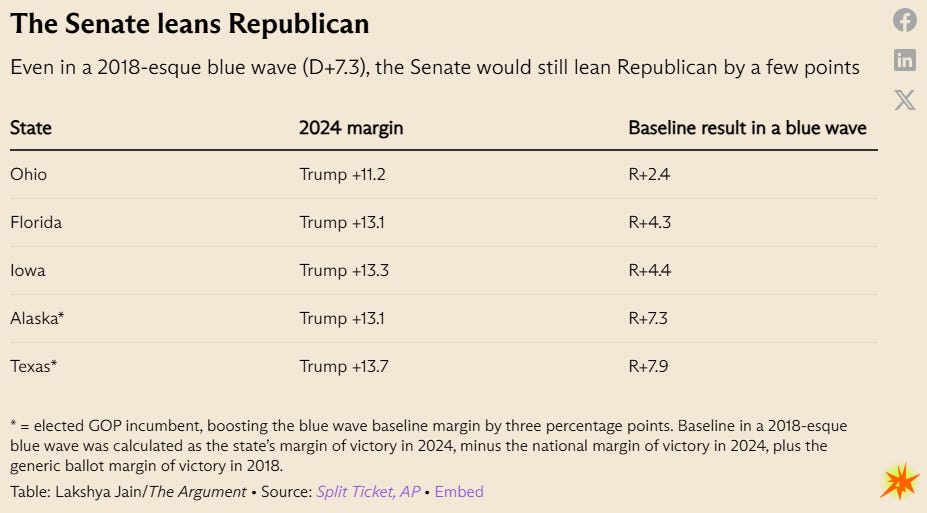
Silver’s state-level generic ballot estimates tell a similar story: at present, with the Democrats leading Republicans nationally by 5.6 points, the GOP is still favored in all four states. His projections also show that Democrats would likely need the national environment to shift at least five more points in their direction—a D+10.6 wave, the largest House margin in a midterm election since 1982—to start putting some of them in play.
Of course, forecasts and projections are not definitive, and real-world factors such as candidate quality and fundraising can make a big difference. There is also still a long way to go between now and November, and if Trump’s second-term policies keep pushing away many of the people who helped make him president, things could change in a hurry. But all this is a reminder of why it is so important for Democrats to figure out a way to compete in places that lean to the right of the country—and soon.
Calculating median seat loss offers an even starker picture: zero seats lost when approval is above 50 percent versus four seats lost when it is under 50 percent
The 2022 midterm is slightly less instructive, as only one seat changed hands—Democrats won an open race in Pennsylvania to succeed Republican Pat Toomey. Democrats’ off-year turnout advantage helped them blunt a red wave in swing states, even as Biden’s approval rating was underwater.
Though we believe both Democratic candidates have serious vulnerabilities, Talarico clearly looks to be the stronger general election candidate.
We excluded Florida from our list because we do not believe at this time that it will be competitive. Florida’s political landscape has been trending decisively away from Democrats in recent years. The party also lost its most promising candidate last summer, and so far none of the others appear to be presenting much of a challenge to incumbent Republican Ashley Moody.
Why is a Substack called The Liberal Patriot devoted almost exclusively to how Democrats can cobble together enough votes to avoid examining their ideas and policies?
It seems a little incomplete to fail to mention Sherrod Brown is 75 years old and historically a huge supporter of unions and US labor. Yet, Brown recently went to bat to keep Ohio Haitian factory workers in the US. They work for $15 bucks an hour, because most have enjoyed housing vouchers and a plethora of other subsidies, not available to the locals.
Business owners embrace cheap migrant labor. Less so, the Buckeyes who must compete with them for jobs and wages. Ohio migrant caused fatal car accidents have surged the past few years. The 4 IN Amish men recently killed by a migrant semi driver, perished 30 miles from the Ohio state line. The notion the wreck was not news in Ohio, seems unlikely.
In Texas, Beto had a King's war chest, the cover of Vanity Fair, a Kennedy comparison, a genuine love of Whataburger and fluent Spanish. He still did not win. Perhaps I underestimate the extent of Trump loathing, but Talarico is AOC in a Minister's collar. He seems to believe Socialism will be more palatable to Texans, covered in Bible passages, like the scripture is BBQ sauce. Crockett defies description. She is literally to the Left of AOC. Paxton is the Rep wildcard,, but still hard to imagine either James or Jasmine winning.
Also the Open Border is a different animal in Texas. We were under siege for years. When Abbott bused the tiniest fraction of migrants to Blue cities, the Biden WH toyed with implementing a "remain in Texas" policy. The Dem gem intended to place ankle monitors on millions of migrants and legally require them to remain in Texas for the years it took to adjudicate their asylum claims. It seems unlikely Reps will not remind Texas voters of the bullet they just barely dodged, at Dem hands.
Finally, Youth is great for energy. It is not great for avoiding foot in mouth syndrome like "mediocre Black Man" and "Governor Hot Wheels". Whoever wins the Dem Primary, must navigate the next 8 months without a self inflicted vocal shot. That may be easier said than done.