



Can Democrats be effective populists? They’d certainly like to believe so. They’d particularly like to believe that if they turn up the volume high enough on economic populism, they can neutralize Trumpian populism and direct anger at the true elites who preside over a broken system. For example, Texas Democratic Senatorial candidate, James Talarico, generally seen as the Democrats’ best shot for flipping that state’s Republican-held Senate seat, has this pitch:
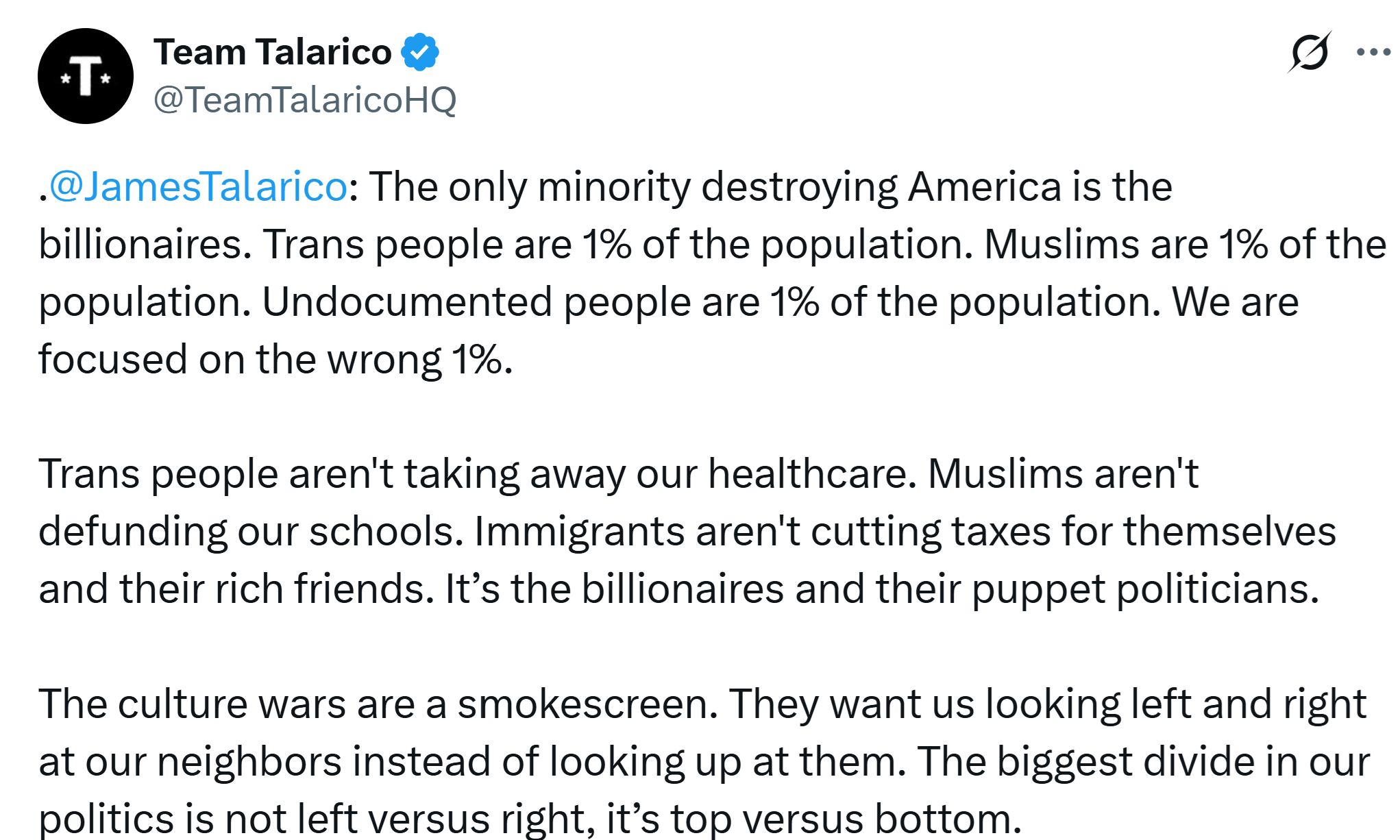
Similar pitches are being made by many Democratic candidates and office-holders, including Graham Platner of Maine and the party’s shining new star, New York City mayor Zohran Mamdani. What they have in common is a complete lack of interest in addressing what Talarico refers to as “the culture wars.” The real issues are economic; the culture stuff isn’t important (“a smokescreen”) and not negotiable anyway.
Can the Democrats get away with this? Can an economics-only populism really succeed in a populist era where anger at elites is so widespread and so many voters see the system as completely broken?
The answer is no. This narrowly-defined populism is doomed to fail.
An aggressive economic populist pitch by itself is not a get-out-of-jail free card for a party whose brand among working-class voters has been profoundly damaged. It’s just a comforting myth for Democrats who don’t want to make hard choices.
Working-class voters are acutely aware that the professional-dominated educated upper middle class who occupy positions of administrative and cultural power is overwhelmingly Democratic. For the working class, the professional upper middle class may not be the super-rich but they are elites just the same. These voters harbor deep resentment toward the cultural gatekeepers who they feel are telling them how to live their lives, even what to think and say, and incidentally are living a great deal more comfortably than they are.
This is a bitter pill for most Democratic elites to swallow. In today’s America, they are the “Establishment” even if in their imaginations they are sticking it to the “Man” and fighting nobly for social justice. The failure to understand that they themselves are targets of populist anger is a central reason their populist pitch fails—and will fail—to get traction among the working class. Call it the “old wine in new bottles” problem—these voters hear the economic populist words but they sense that behind them is the same old Democratic Party with the same old elites and the same old cultural priorities.
It therefore follows that Democrats’ attempts to pose as populists will fail to convince without a strong dose of cultural populism. Unless Democrats are willing to align with populist sentiment on cultural issues and therefore confront their own elites and associated NGOs and institutions, working-class voters will not take them seriously as populists, viewing them merely as an alternative set of elites.
And an alternative set of elites who do a very poor job governing where they have the most power. Here again Democrats’ purely economic populism falls short. Deep blue states and cities are notoriously reluctant to confront the NGO-activist-industrial complex and the congeries of interest groups, including public sector unions, who drive up costs and make it near-impossible to govern efficiently and preserve social order. For ordinary voters, this amounts to siding with the Democrats’ own elites against the people.
No wonder that even with the thermostatic reaction against Trump and his administration’s excesses and failures, Democrats as a party are still not deriving commensurate benefits. As my Liberal Patriot colleague Michael Baharaeen notes:
[I]t is not yet clear that Trump’s woes have brought his party down with him. For example, polling shows that voters continue to trust Republicans more than Democrats on immigration and the economy, which the [New York] Times’s survey identified as the two most important problems facing the country today. There are also signs that Republicans may be retaining some of Trump’s gains with core segments of the electorate, even as he himself has stumbled.
[Comparing how groups voted in the national House popular vote in 2018, and where their support lies now], it appears that a meaningful share of younger and non-white voters have moved to the right and may be staying there. The most glaring shifts are from racial minorities. In 2018, Democrats won black voters by 84 points and Hispanics by 40 points. Today, those leads are down to 55 points and 16 points, respectively. And even though voters aged 18–29 have soured on Trump, they are still 11 points right of where they were eight years ago.
As Baharaeen also notes, the one group that has moved most meaningfully to the left over the period is white college graduates (by 12 points). This group of course heavily populates the very elites that “populist” Democrats are so reluctant to confront.
Democrats will eventually have to take on cultural populism as part of their brand or just give up on ever being a working-class party again. Simple economic populism is hopelessly inadequate. The voters they need to reach overwhelmingly believe illegal immigration is wrong and should be deterred and penalized not indulged. They believe crimes should be punished, public safety is sacrosanct, and police and policing are vital necessities. They believe, with Martin Luther King, that people should “not be judged by the color of their skin but by the content of their character” and therefore oppose discrimination on the basis of race no matter who benefits from that discrimination. They believe biological sex is real, spaces limited to biological women in areas like sports and prisons should be preserved, and medical treatments like drugs and surgery are serious interventions that should not be available simply on the basis of declared “gender identity,” especially for children.
So where are the Democrats’ cultural populists who are willing to robustly defend these sentiments? Essentially non-existent. That bodes poorly for the party’s long term prospects and likely ensures a long life for right populism to the country’s detriment.
I’m a member of the affluent white upper middle class PMCs (like most of us, I assume). I live in a blue neighborhood in a blue state. Houses start at about $650k and can easily double that. Unskilled illegal immigrants aren’t buying houses here. They’re renting apartments in much cheaper working class neighborhoods-thereby driving up rent. (Recall that it’s hard to build even in red states, let alone blue).
But my leftist neighbors pat themselves on the back about how kind and empathetic they are, unlike all the hate-filled and bigoted poor whites.
Here is the key phrase from Ruy that encapsulates the elite liberal mindset: "The real issues are economic; the culture stuff isn’t important (“a smokescreen”) and not negotiable anyway."
To elite liberals, the culture stuff IS important, emphatically so. If you disagree with them on these issues - even one of them - you are labeled as retrograde (or worse), and if you're an aspiring Democratic politician you are not worth supporting whatever your positions are on other issues. The culture stuff is a screening device: conform 100% to the woke dogmas or give up your political aspirations.
Of course, the salience of culture issues will depend on how well things are going in the economic and foreign policy areas. A deep recession in 2028 will bring Democrats to power, no matter how crazy they are regarded to be on culture issues. Same for a foreign policy calamity, especially a major military defeat. I repeat here for the umpteenth time: a genuine moderate Democrat - a liberal patriot - can win bigly in 2028 if he/she can somehow overcome the crazed Left that currently controls the Democratic nominating process.