



Last month, at the one-year anniversary of Donald Trump’s inauguration, New York Times political analyst Nate Cohn took a look at the state of the president’s 2024 coalition. According to his data, many of the voters who helped make Trump president for a second time have swung hard against him over the past year, including, notably, racial minorities and young voters. Both groups have historically voted heavily Democratic, but Trump made significant gains with them in 2024. Now, however, both support him at lower rates than they did not just in 2024 but in 2020 as well.
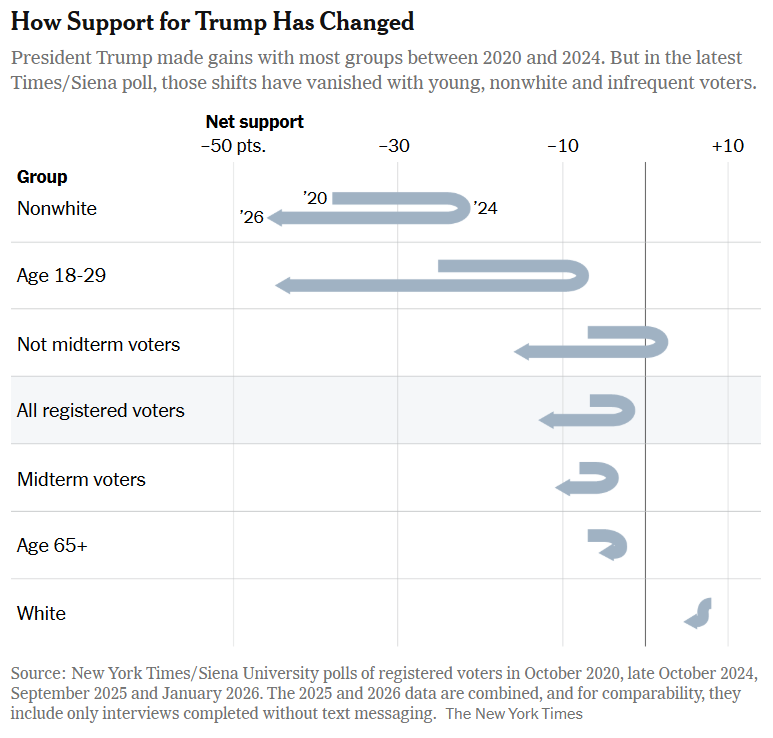
Suffice it to say, this is far from ideal for Trump—and for his party, which faces an uphill battle heading into this year’s midterm election. Historically, the president’s party performs poorly in midterm years, and the lower the incumbent’s approval rating, the worse the carnage tends to be. In the Trump era, the GOP has also begun to rely more on less-frequent voters to win. If, as Cohn’s data shows, some of them even start to turn on Trump and instead go back to supporting Democrats, things could get ugly very quickly for Republicans.
Yet, as we regularly note, Democrats have not fully capitalized on Trump’s struggles so far and face issues of their own. Their favorability rating remains even lower than his—including among independents—which represents a reversal of where things were at the same point in 2018, the last midterm cycle under Trump. Democrats’ lead in the generic House ballot test today is also four points behind where it was at that time, even as many polls suggest they have near-unanimous support from their own voters.
Additionally, it is not yet clear that Trump’s woes have brought his party down with him. For example, polling shows that voters continue to trust Republicans more than Democrats on immigration and the economy, which the Times’s survey identified as the two most important problems facing the country today.
There are also signs that Republicans may be retaining some of Trump’s gains with core segments of the electorate, even as he himself has stumbled. Here is a look at how some of them voted in the national House popular vote in 2018 versus where their support lies now:
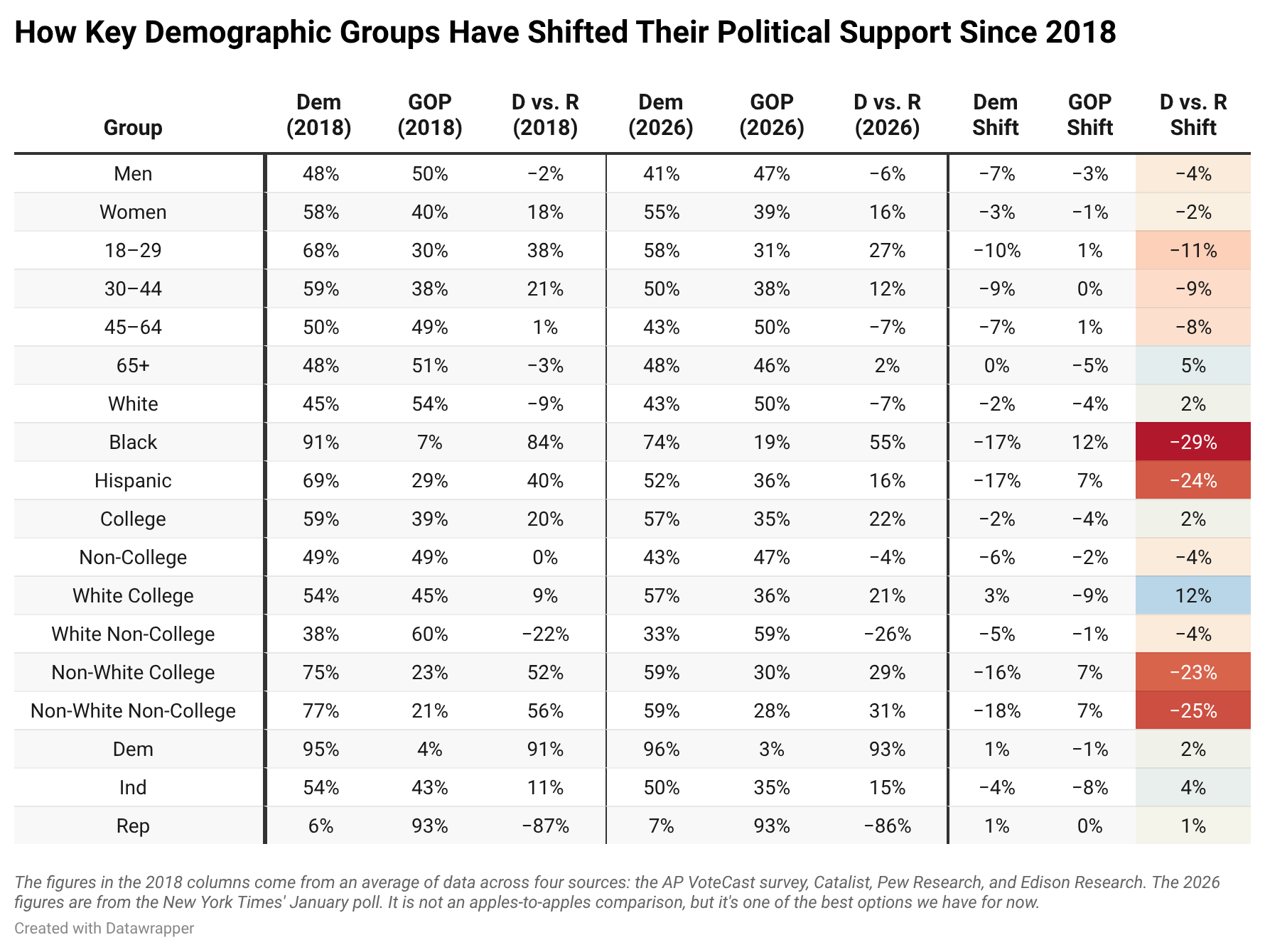
These numbers are generally consistent with what we’ve seen in recent years: it appears that a meaningful share of younger and non-white voters have moved to the right and may be staying there.1 The most glaring shifts are from racial minorities. In 2018, Democrats won black voters by 84 points and Hispanics by 40 points. Today, those leads are down to 55 points and 16 points, respectively. And even though voters aged 18–29 have soured on Trump, they are still 11 points right of where they were eight years ago.
There is certainly some good news here for Democrats, too. For starters, they have continued to make gains with white college grads, who are some of the most reliable voters in non-presidential years. Moreover, the Times’s polling shows there are relatively high shares of undecided voters across several cohorts, including young voters (11 percent), Hispanics (12 percent), non-college voters (10 percent), and independents (15 percent). If Democrats simply break even among these outstanding voters, it could leave them well-positioned for a strong midterm election.
But this data suggests that some of Republicans’ gains during the Trump era are very real. After only winning seven percent of black voters in 2018, Trump improved slightly in 2020 and then doubled that vote share in 2024 to 15 percent. In the Times’s generic ballot test, Republicans today are at 19 percent. This means that Democrats’ margin drop from 84 points to 55 isn’t just due to a high number of undecided black voters but real movement to the right.
We see a similar story with Hispanics: Republicans won only 29 percent in 2018, but today they are at 36 percent (though this trails Trump’s 46 percent from 2024). That means that even if Democrats ultimately clean up with the 12 percent who are undecided, their margin over Republicans would still be lower than it was in 2018.
Why does this data matter? Because of the stories that Democrats tell themselves about the state of their coalition. If they think that Trump’s gains in 2024 were a fluke—more of a “de-alignment” than a realignment, as some analysts on the left have argued—they risk convincing themselves that their lost voters will come back to them without Democrats needing to do much to precipitate that movement. They may, for instance, assume they will by default reap the rewards of Hispanic backlash to Trump’s immigration enforcement. This would be a mistake. Rebuilding a durable, winning coalition requires finding ways to reconnect with the voters who not long ago left them for Trump, and who may have a hard time trusting them after the Biden years.
It is of course possible that the above data won’t have much bearing on the midterms. Many of the Trump voters who have grown bitter toward him are likely to be those infrequent voters with weaker partisan loyalties, and they may simply sit out the election entirely, which would still work in Democrats’ favor. But these trends also illuminate longer-term shifts that will certainly matter for 2028 and beyond.
As you guys know, I discount polls including the recent one showing Trump at 50%.
I thought Ds were starting to turn it around in PA when, for 2 straight reports, they made minimal gains there . . . but nope. Back to GOP gains yet again, suggesting internal pushes for registration. The idiotic "jungle primary" scheme to perpetually elect Ds in CA is backfiring now, with the top two in the governor's race according to "ahem" polls being Rs. After pruning MN of 13,000 illegals, Trump moved out, but the deportations continue at record pace. I know you don't like to hear it but yes, many of these people vote, and no, they won't be voting D any more. Let's say it's "only" 50% who vote, so with 3.5m gone in just 14 mo., the Ds have nationally lost another 1.7 million off their rolls, not even mentioning the continued D-R or D-I registration shifts in every state we can track. Loosely, this translates to another 2m net Rs (or 2m fewer Ds) than just 14 months ago.
Somehow, Rs have hung on since Nov. to win 4/7 special elections, though the one in TX got all the media.
And despite the Supes ruling, the economy is starting to really heat up again. I maintain my prediction that Rs hold the House by 2-5, add a NH seat in the Senate. And J.D. Vance is still on my scorecard at 320 EVs in 2028, but as I'm sure you've noticed there is a three-way battle for the D nomination among Newsome, Mamdani, and Harris. I don't know why Ds don't like Newsome, but apparently they don't, and 30% love the Amazing Zohran and wouldn't care what the constitution says about nominating him. I think this explains the recent Harris push---she is the only one capable of NOT being blown out (but would still lose).
Excellent points. While affordability is likely to hit most US families with similar paychecks in a similar manner, geographic location may end up being more important than Party affiliation, regarding Immigration.
If only a few migrants arrived your area, the effect on housing, healthcare, schools and jobs was likely limited. Watching ICE toss anyone to the ground, even those obviously physically resisting arrest, will likely look like overkill.
Especially for a Dem ruling class often dwelling behind gates, with privately educated children. 3 migrant children, speaking 3 different languages, are unlikely to interrupt their 3rd graders reading lessons, or lessen teacher time. The local ER may now have a slightly longer line, but their Concierge Doctor's office remains uncrowded.
Texas, on the other hand, was hit with the full force of the wave for years, and is still attempting to deal with the fallout. CA spends nearly $8.5 billion annually, just on migrant healthcare alone, before massive education and other costs. That is with 54% of all US immigrants, dwelling both legally and illegally, also enrolled in federal welfare programs. If federal welfare actually ends for them, some state budgets will have little hope, but prayer.
Perhaps much the rest of the country is over Immigration as an issue, except to despise ICE. The midterms are still the better part of a year away. We shall see how the economy shakes out, if unexpectedly large tax refunds appease many, if Iran is Mullah free, and if memories of Biden's border fiasco fade.