



Today marks one year since Donald Trump was sworn in for a second term as president. After looking stronger than ever before on Inauguration Day, most metrics show that his standing with the public has since declined substantially.
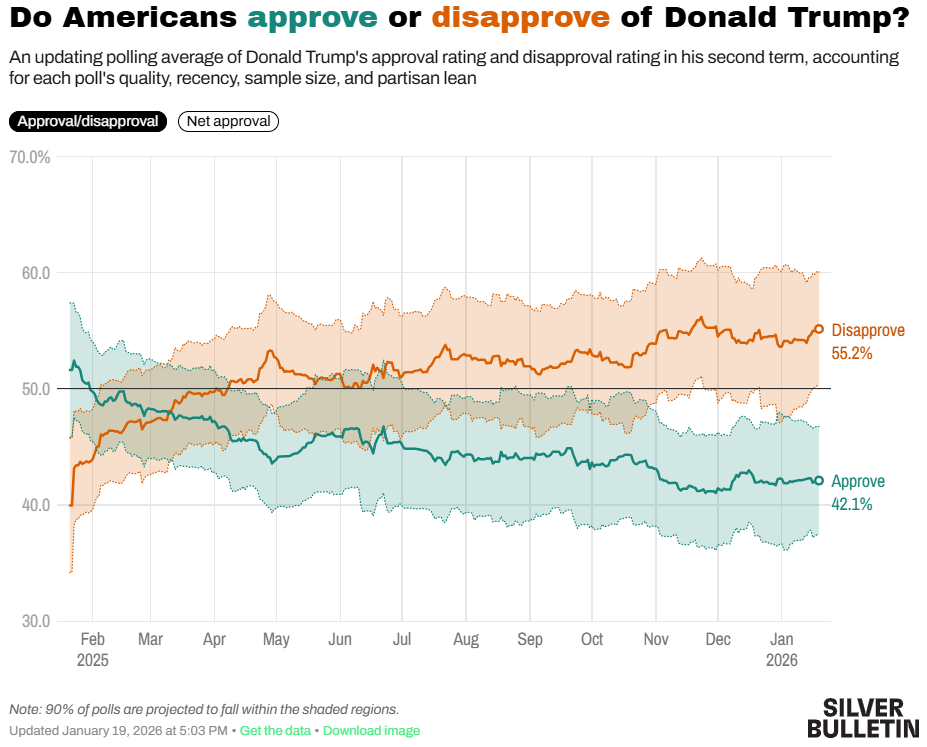
According to averages compiled by Nate Silver, Trump’s approval rating as of this week sits at just 42.1 percent against a disapproval rating of 55.2 percent, good for a net approval of -13.1. At this time last year, that figure was +11.7, marking a 24.8-point swing. His current standing puts him even slightly below where Joe Biden was at the same point in his presidency (-12.2).
The severity of Trump’s political decline is evident in how Americans feel he has handled some of the top issues facing the country—specifically, immigration and the economy. A new Wall Street Journal poll examined his approval rating across ten issues, and on eight of them he held a double-digit net-negative approval, including inflation and prices (-17), tariffs (-10), and the economy overall (-10).1 He also struggled on related questions, including whether voters believed he is looking out for the middle class (-12) and has the right priorities (-14).
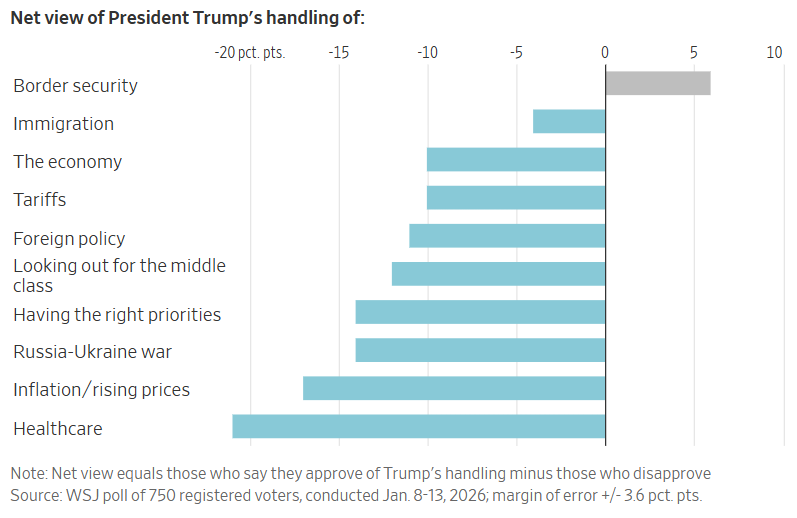
On just one issue—border security—was his net approval in positive territory (+6). Immigration ranked second-best at -4, consistent with numerous other polls across the past year. However, even there, the public has been growing restless about some of his policies. According to Silver’s data, throughout the second half of 2025 Trump’s net approval on immigration was four to five points underwater on average, far better than for economic issues. This month, however, it dropped below -10 for the first time. The Journal also found that majorities of voters believe Trump has gone too far in deploying ICE agents and deporting people living in the U.S. illegally.
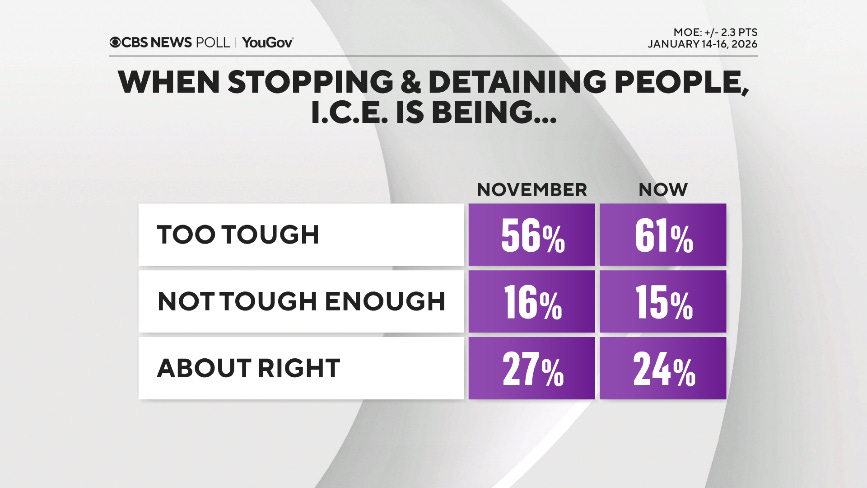
CBS and YouGov conducted an even more in-depth survey gauging voters’ views on how Trump has handled immigration, and the picture remained poor for him overall. Take the topline finding: since last February, support for his deportation program has declined significantly, falling from +18 points (59 to 41 percent) to -8 today (46 to 54). Fully 61 percent of Americans—including 68 percent of independents and even one-in-five Republicans—believe ICE has been “too tough” when stopping and detaining people, up five points since November.
The rest of the survey didn’t get much better for him. Far greater shares of Americans reported feeling uneasy (54 percent), frustrated (51 percent), unsafe (47 percent), or exhausted (42 percent) by Trump’s presidency than felt confident (25 percent), satisfied (21 percent), safe (20 percent), or energized (18 percent). Moreover, majorities said he has given too much attention issues like deportations (53 percent), international/overseas events (53 percent), and imposing tariffs on other countries (60 percent), while a whopping 74 percent believe he has not paid enough to “lowering the prices of goods and services.”
Big picture: Americans are (still) primarily worried about their finances, think Trump is too preoccupied with other matters, and increasingly disapprove of how he is handling most issues.
Frustration with an incumbent president typically presents an opportunity for the opposition party. Indeed, Democrats have already found much political success over the past year, and the midterm environment is shaping up to favor them overall. But whether they can capitalize on Trump’s poor standing has yet to be determined, and as we have warned previously, negative attitudes toward him may not automatically translate into support for the party—a warning that recent polling has reinforced.
Despite their misgivings about Trump, voters still trust Republicans in Congress more than Democrats to handle most big issues. In the same Journal poll, voters were asked which party they prefer to handle ten issues, and they chose Republicans on seven of them. By far the GOP’s best-performing issues related to immigration, a reminder of the hole Democrats find themselves in after Biden’s four years. A meager 20 percent of voters trusted Democrats to handle border security versus nearly half (48 percent) who picked Republicans.
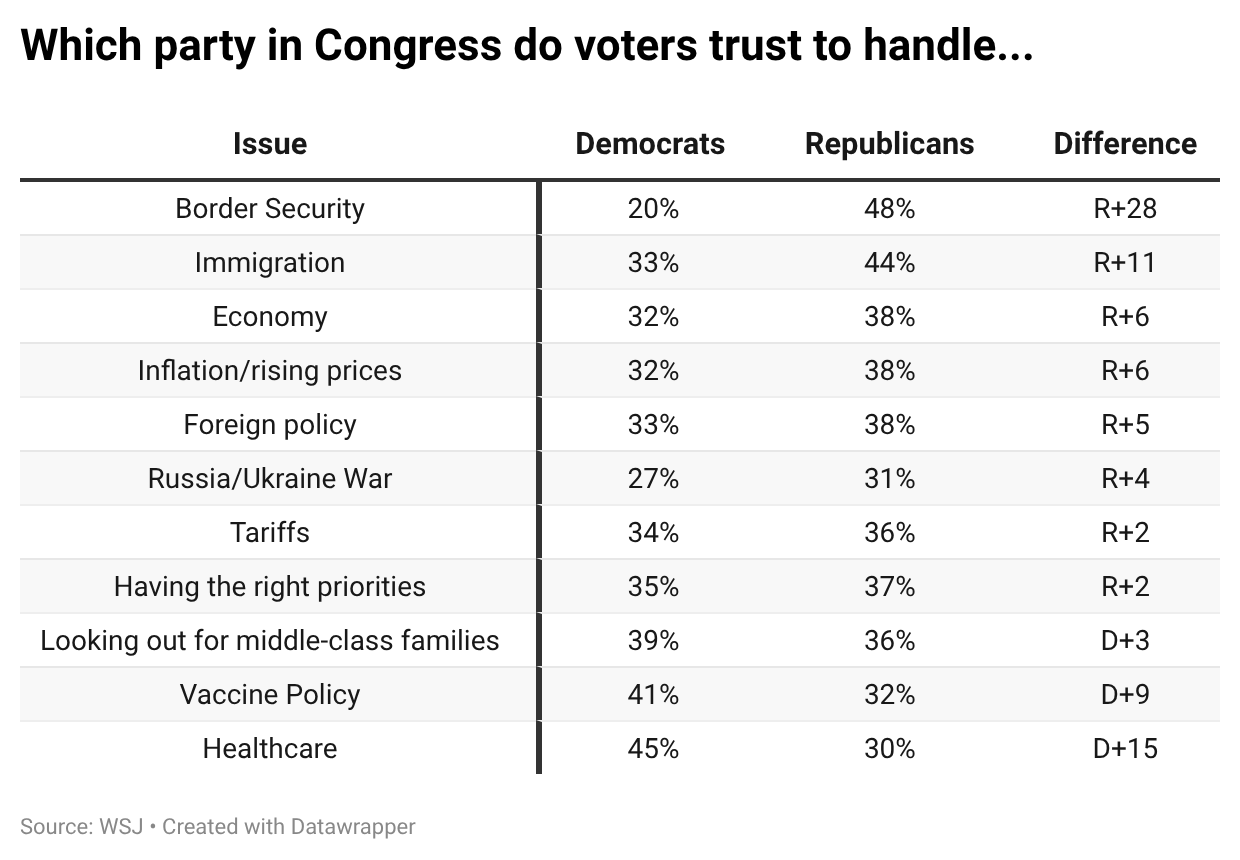
Moreover, even as Trump’s approval for handling economic issues has been in the gutter for months, Republicans continue to hold an advantage on inflation (+6), tariffs (+2), and the economy overall (+6). The CBS poll told a similar story: Americans preferred Trump and Republicans’ approach on both economic and immigration policy to the Democrats’.
Unsurprisingly, Democrats’ best issue is still health care, as it has been for years. The party may be comforted by the knowledge that in the lead-up to the 2018 midterm election—the closest parallel to the current election cycle—polling looked pretty similar regarding whom voters trusted more on health care (D+16) and the economy (R+9). And that November, Democrats experienced a “wave” election.
The one issue that is very different this time, however, is immigration. Americans have become quite a bit more restrictionist on dealing with illegal immigration compared to eight years ago. In the CBS poll, they were evenly split on whether those living in the U.S. illegally should be allowed to stay and apply for citizenship (46 percent) or required to leave (45 percent). Similarly, while the public leaned heavily against Trump’s approach to deportations, they were split 50–50 on supporting his goals.
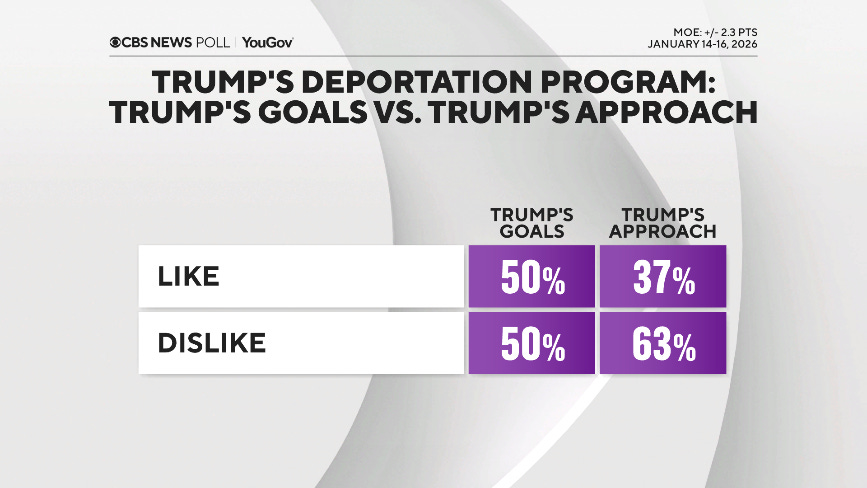
It’s very possible this won’t matter much in the November election. The out-party typically sees success in midterm years, even when they have deficits of their own. Democratic voters will no doubt be fired up to turn out, and the impact of Trump’s first-year moves on health care might allow the party to press its advantage on the issue with swing voters. But the fact that Democrats don’t hold a trust advantage on immigration or the economy—Americans’ top two issues in the CBS poll—may pose a challenge for them in more competitive races, and even beyond this year.
All we know for certain right now is that Trump’s woes are hurting Trump. Maybe they will end up trickling down the ballot and making life difficult for his party, as well. But tempting as it may be to hope all this will help buoy them back to good standing, it is clear Democrats still have work to do to get back in voters’ good graces.
These figures are even lower in Silver’s averages: -24 (inflation), -16 (trade), and -16 (the economy generally).
How would they capitalize on anything with no ideas other than junk their progressive wing picks up from neo-Comminists? I’m asking this seriously - do they have any ideas other than “Resist!” and moronic DSA slogans. Are they going to abolish ICE and open borders? Are they going to remove sanctions from the Islamic Republic of Iran and the Houthis?
Totally off topic but I thought the commentators here lean too far right - too *much* agreement - so I went to Matthew Yglesias' substack and was banned in 24 hours.
He has the right to prune his commentators as he wishes, but it was an interesting experiment. I appreciate the diversity of thought here! Lesson learned.